
Chapter 1: Introduction
Banknote counters as well as the machines related to cash handling are critical instruments used in banks, retail outlets, casinos, banking institutions, as well as cash handling centers. It is in such an application with very high precision demands that the tubular pull-type solenoid valves are major contributors as the electromagnetic actuators, the key responsibility of which is the execution of very fast mechanical operations like gate control, banknote separation, braking, as well as banknote rejection.
Compared with conventional framed/open solenoids, tubular pull solenoid feature higher force density, faster response speed, higher magnetic efficiency, and superior mechanical alignment properties. Regarding banknote verification systems, this article devotes itself to an engineering analysis of tubular drawing solenoids in relation to requirements for their use, logic of selection, design, testing and verification, merits and demerits, as well as expertise on practical problems.
Chapter 2: Application Requirements of the Currency Counter System
Currency counters work in a harsh environment of mechanics and electricity. The operating requirements of tubular pull-type solenoid valves need to meet the system-level needs.
2.1. Rapid response speed and repeatability
- The banknote counting machines normally work at a speed that ranges from 800 to 1500 banknotes every minute. The solenoid valve needs to:
- Response within milliseconds
- Provides consistent striking power.
- Aids in ensuring repeatability on a cycle-to-cycle
- Inaccuracies in system dynamics could cause incorrect counting and/ or jammed notes.
2.2 Exact mechanical control.
- Tubular pull-type solenoid valves are generally preferred as the actuation means.
- The gating mechanism is very important.
- It needs to counterfeits and faulty money.
- Brake or clutch components.
- Sorting dividers
- Such operations require controllable linear movement, precision placement in a stroke, and reliable rebound.
2.3. Low noise levels and smooth running.
The money counters typically work in an office or banking atmosphere. High electromagnetic interference or physical vibrations might directly influence user experience and quality perception.
2.4. Long life despite strenuous schedules.
- Commercial banknote detectors operate under intense load, often performing hundreds of thousands of operations every day. The solenoid valve, consequently, has got to withstand:
- Frequent cycling at high speeds.
- Continuous exposure to heat.
- The mechanical wear and tear of its moving parts.
2.5 Space-saving design and adaptable integration.
- Contemporary banknote detectors are made with compact modular design concepts in mind. Tubular pull-type solenoid valves are often used in:
- Constrained installation environments.
- Online mechanical configurations.
- Ease of installation and alignment.

Chapter 3: Why is a tubular pull-type solenoid valve the go-to option?
The tubular solenoid’s structural and electromagnetic properties render it especially well-suited for application in banknote detection systems.
Key structural attributes include a cylindrical magnetic circuit characterized by a symmetrical magnetic flux distribution. Furthermore, an enclosed steel casing enhances magnetic efficiency. A precision guide plunger, designed with minimal lateral clearance, is also a critical component. These design elements collectively contribute to stable force output and mitigate wear during high-speed operation.
Chapter 4: Considerations for Selection and Engineering Design
4.1. Solenoid valve operating mode
The pull-type operation is the standard configuration, producing maximum force at the commencement of the stroke, which is advantageous for rapid gate opening and braking actions. The selection between a spring reset mechanism and a gravity reset mechanism should be based on the desired response speed and the mechanical layout.
4.2. Main electrical parameters
The rated voltage is typically 12V or 24V DC, ensuring compatibility with control boards. The duty cycle can be either intermittent or high-frequency pulse operation.
Power consumption is carefully managed to keep heat generation to a minimum during prolonged use.
Pulse width modulation (PWM) is frequently employed to dial down the holding power once a drive is engaged.
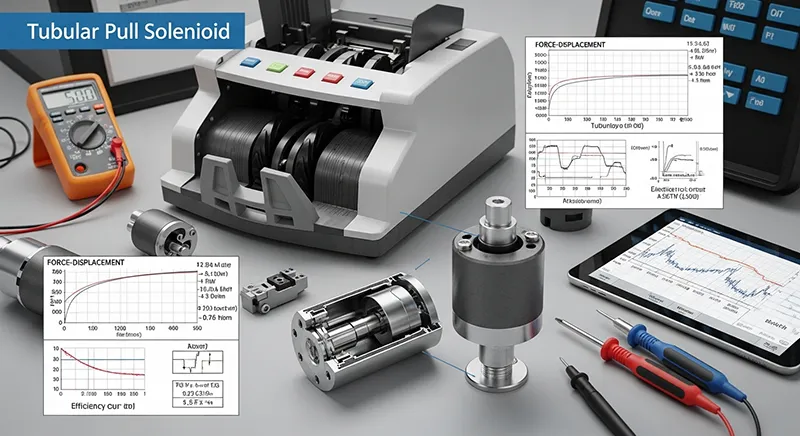
4.3. Force-stroke matching
Getting the force-stroke curve just right is key:
A strong initial tension gets things moving quickly.
A solid end force keeps a secure grip.
Over-engineering can lead to more noise and wasted energy.
Engineering simulations and physical tests are strongly advised during the selection process.
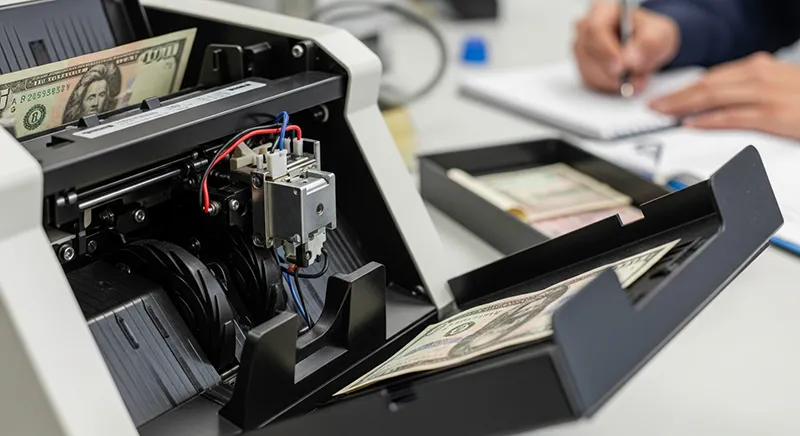
4.4. Mechanical integration
Inline installation boosts the efficiency of force transmission.
Shock-absorbing pads can help quiet impact noise.
Hardened or coated plungers can last longer.
Precise alignment cuts down on friction and sticking.
Chapter 5: Implementation and Debugging
The tubular pull solenoid’s performance necessitates validation under realistic operational conditions throughout prototype development and system integration.
Essential debugging procedures include:
- Response time assessment: Confirm that the solenoid’s actuation falls within the specified design parameters.
- Stroke accuracy confirmation: Validate the integrity and unobstructed nature of the mechanical stroke.
- Noise level measurement: Ensure that the noise produced within the office environment does not exceed 45 dB.
- Heat rise evaluation: Monitor the coil temperature during periods of peak load.
- Early optimization efforts can substantially diminish the incidence of field failures.
Chapter 6: Performance and Reliability Verification
Prior to mass production, thorough verification is essential to confirm long-term stability.
The following test is recommended:
- Life cycle testing: Subject the solenoid to a minimum of 5 million cycles under actual load conditions.
- Heat resistance: Capable of enduring sustained high-frequency pulses at elevated temperatures.
- Vibration and shock testing: Mimicking transport and operational vibrations.
- Electrical stability: Assessment of voltage fluctuation and electromagnetic compatibility immunity.
- A properly engineered tubular pull solenoid valve can maintain force deviation within ±5% throughout its operational lifespan.
Chapter 7: Advantages and limitations of utilizing over-the-counter currency applications
Core advantages
- High force density within a compact form factor.
- Swift response and superior repeatability.
- Tubular guides mitigate lateral wear.
- Reduction of electromagnetic noise.
- Facilitates modular integration.
- Potential limitations
Heat buildup is a concern when operating under extreme conditions. The cost of the unit is higher than that of a basic open-type solenoid valve. The installation process is very sensitive to misalignment. A well-designed drive circuit is essential. These limitations can be reduced through careful systems-level engineering.
Chapter 8: Common Problems and Engineering Solutions
Problem Engineering Solutions
- Slow response or no trigger: Increase drive current briefly; optimize the PWM curve.
- Excessive noise: Add damping pads; reduce impact speed; optimize the stroke.
- Overheating issues: Improve airflow; reduce the duty cycle; enhance coil insulation.
- Piston jamming; improve alignment; add surface coating; remove debris
- Pressure drop; check voltage stability; replace worn springs
Chapter 9: Summary of Experiences: Best Practices in Key Projects
In high-speed counting, force stability is more important than peak force.
PWM drive strategy significantly improves efficiency and lifespan.
Noise control must be considered as early as possible, rather than as an afterthought.
Thermal margin determines long-term reliability
Mechanical alignment directly affects service life.
Chapter 10: Sum Up
In modern banknote counting machines, the tubular pull-type solenoid valve, as a key electromagnetic actuator, directly determines the counting speed, accuracy, noise level, and long-term reliability. Through reasonable force-stroke matching, optimized electrical drive design, meticulous mechanical integration, and rigorous life cycle testing, the tubular pull-type solenoid valve can provide fast, accurate, and repeatable motion even under extreme working cycles.
As cash handling equipment continues to evolve towards higher speeds, lower noise, and smarter control systems, tubular pull-type solenoid valves will remain a cornerstone technology—constantly improving in efficiency, durability, and integration flexibility to meet the demanding requirements of next-generation banknote counters.
