
Chapter 1: Introduction
With the continuous improvement of automotive intelligence and safety standards, the lighting system has evolved from a traditional lighting component to a highly integrated mechatronic module. Among them, solenoids are widely used in key positions such as high-low beam switching, Adaptive Front-lighting Systems (AFS), and matrix headlight shading mechanisms due to their advantages of fast response, compact structure, and precise control. From a practical engineering perspective, this article systematically introduces the application process, core advantages and disadvantages, common problems, and corresponding solutions of solenoids in automotive lighting, providing reference for relevant engineering practices.
Chapter 2: Scenario Requirements: Challenges of Actuators for Automotive Lighting Control
In modern automotive lighting systems, actuators need to meet multiple stringent requirements:
- Fast response speed: High-low beam switching usually requires completion in milliseconds to ensure driving safety;
- Limited structural space: The internal integration of automotive lights is high and space is compact, placing extremely high requirements on the volume and installation method of the actuator;
- Strong environmental adaptability: It needs to withstand complex environments such as high temperatures in the engine compartment, driving vibrations, rain and snow humidity, and road dust for a long time;
- Long reliable service life: It needs to match the entire vehicle life cycle, work stably for hundreds of thousands of times or more, and operate without failure.
Traditional motor solutions have certain limitations in terms of cost, structural complexity, and response speed, while solenoids can precisely match these typical scenario requirements, making them the preferred solution for automotive lighting actuators.
Chapter 3: Solution Design: Solenoid Selection for Automotive Lighting Applications
In the solution design stage, targeted design should be carried out around the lighting function and system constraints to ensure perfect adaptation between the solenoid and the automotive lighting system:
3.1 Solenoid Type Selection
DC push-pull solenoids are mostly used in automotive lighting applications, mainly for driving the rapid displacement of light-shielding plates or reflectors to achieve high-low beam and light pattern switching; in AFS and matrix headlight systems of some high-end models, holding solenoids are introduced, which realize power-off holding function through permanent magnets, greatly reducing power consumption in the continuous energization state and meeting the automotive energy-saving requirements.
3.2 Key Parameter Design
Operating voltage: Strictly match the automotive power supply system, usually 12V or 24V DC voltage is selected to ensure compatibility with the entire vehicle power supply system;
Suction force and stroke: Precisely calculate according to the weight of the light-shielding plate and the transmission resistance of the mechanism, and reserve reasonable redundancy to avoid insufficient suction force in the later stage due to mechanism wear;
Coil design: Optimize the number of coil turns and wire diameter to balance response speed and temperature rise control, avoiding coil overheating damage during high-frequency operation.
3.3 Automotive-Grade Design Considerations
High-temperature resistant enameled wire (temperature resistance ≥150℃) and low-noise structural design are selected, and dust-proof and moisture-proof sealing structures are reserved to fully meet the automotive-grade reliability requirements and ensure stable operation in complex driving environments.
III. Implementation and Commissioning: Core Points from Sample to System Matching
In the sample stage, the solenoid needs to undergo multiple rounds of assembly and commissioning with the entire lamp mechanism, focusing on solving problems such as action consistency, noise control, temperature rise, and vehicle system interference, to ensure high matching with optics, structure, and electronic control units:
3.4 Action consistency test: Repeatedly verify whether the solenoid’s suction and release actions are smooth and free of jamming, ensuring synchronized actions of multiple lighting modules;
Noise control: Reduce the “knocking sound” during solenoid operation by adding buffer rubber, optimizing shrapnel structure, etc., to improve the overall vehicle NVH performance;
Temperature rise test: Continuously monitor whether the coil temperature rise is within a safe range in a simulated high-temperature environment of the engine compartment (≥85℃), avoiding coil aging and service life reduction due to high temperature;
3.5 Vehicle system interference investigation and solution: The electromagnetic pulse generated by the solenoid at the moment of on-off is likely to interfere with the vehicle’s electronic systems (such as ECU, radar, and vehicle machine system). Reduce electromagnetic radiation by optimizing the coil freewheeling circuit, adding EMI filter components, and reasonably arranging wire harnesses (away from sensitive electronic components); at the same time, conduct multiple rounds of EMC (Electromagnetic Compatibility) tests to ensure compliance with automotive EMC standards;
3.6 Entire lamp joint commissioning: In the actual vehicle or test bench environment, simulate different driving scenarios (such as night driving, meeting vehicles, turning), verify the stability and consistency of high-low beam switching and light pattern adjustment, and ensure compliance with driving safety requirements.
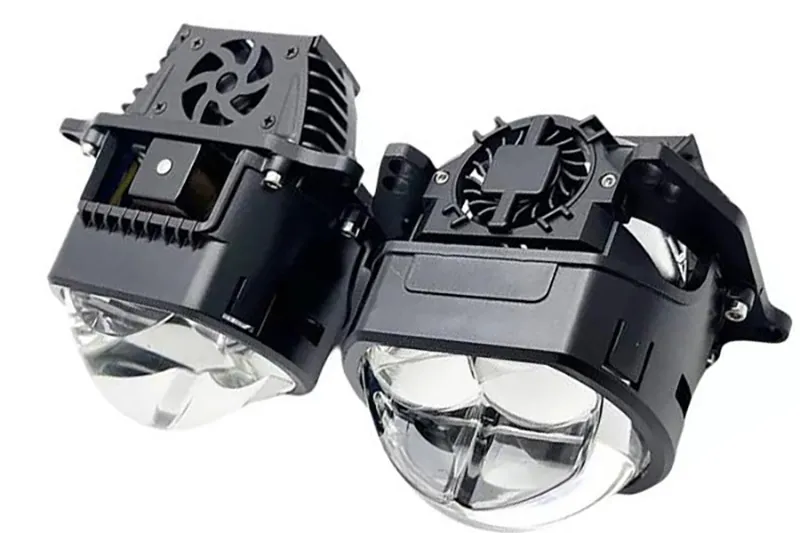
Chapter 4: Effect Verification: Reliability and Performance Evaluation
In the pre-mass production stage, the solenoid needs to pass systematic and rigorous verification tests to ensure it meets the requirements of vehicle mass production:
- Service life test: Conduct more than hundreds of thousands of on-off cycle tests to simulate the usage frequency of the entire vehicle life cycle and verify the solenoid’s action stability and service life;
- Environmental test: Complete high-low temperature cycle (-40℃~150℃), damp-heat cycle, and vibration impact tests to verify reliability in extreme environments;
- Performance consistency test: Batch sampling and testing of the solenoid’s response time and suction error to ensure the consistency of mass production;
- System compatibility verification: Conduct joint commissioning of the entire vehicle host system again to confirm no residual electromagnetic interference, and ensure that the solenoid cooperates accurately with the optical system and the light pattern adjustment meets regulatory requirements.
Verification results show that reasonably designed automotive lighting solenoids have obvious advantages in terms of response speed, reliability, and cost control.
Chapter 5: Core Advantages and Disadvantages of Solenoid Applications in Automotive Lighting
5.1. Core Advantages
- Fast response speed: Millisecond-level action response can accurately match real-time control requirements such as fast high-low beam switching and dynamic adjustment of matrix headlights;
- Compact structure: Small size and light weight, suitable for the narrow installation space inside automotive lights, facilitating modular integration of the entire lamp;
- Simple and precise control: Action control can be achieved through current on-off, and precise adjustment can be completed with a simple drive circuit, resulting in low development costs;
- Balanced cost and reliability: Compared with precision servo motors, solenoids have a simple structure, fewer components, lower mass production costs, lower failure rates, and can easily meet the long service life requirements of the entire vehicle;
- Strong automotive-grade adaptability: Through targeted design, it can easily meet automotive-grade environmental requirements such as high temperature resistance, vibration resistance, dust proof, and moisture proof.
5.2. Core Disadvantages
- Electromagnetic interference risk: The electromagnetic pulse generated at the moment of on-off is likely to interfere with the vehicle’s electronic system, requiring additional investment in EMC optimization;
- Power consumption issue: Non-holding solenoids need continuous energization to maintain working status, which will generate a certain amount of power consumption during long-term use and increase the vehicle’s energy consumption pressure (holding solenoids can alleviate this problem, but the cost is higher);
- Limited action stroke: Due to structural limitations, the push-pull stroke of solenoids is usually short (generally a few millimeters), which is only suitable for short-stroke driving scenarios and cannot meet the requirements of long-distance displacement;
- High requirements for installation accuracy: The action accuracy of the solenoid depends on installation positioning. If the installation deviation is too large, it is easy to cause problems such as action jamming and light pattern offset, increasing assembly and commissioning costs.
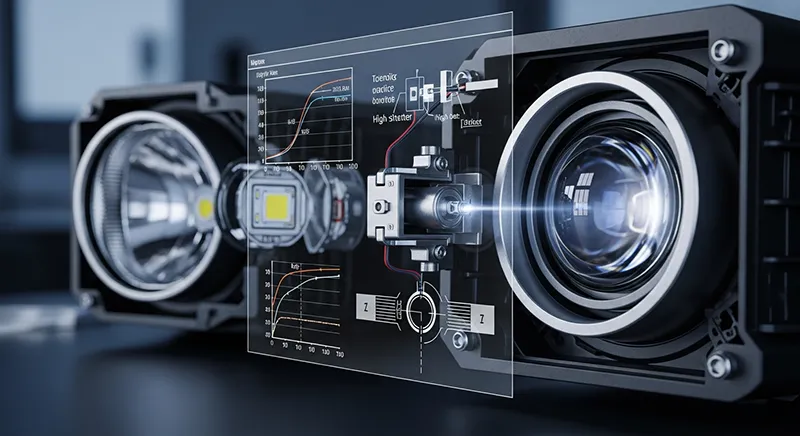
Chapter 6: Common Problems and Solutions in Solenoid Applications for Automotive Lighting
Problem 1: Excessive noise during solenoid operation, affecting NVH performance Solution: Optimize the internal buffer structure of the solenoid and add silica gel buffer pads; adjust the suction gap to avoid hard contact; select low-noise coil materials to reduce electromagnetic vibration noise.
Problem 2: Decreased solenoid suction and slow response in high-temperature environments Solution: Select enameled wire and magnetic core materials with higher high-temperature resistance; optimize the coil heat dissipation structure and increase heat dissipation gaps; reserve temperature rise redundancy in parameter design to ensure that the suction requirement is still met at high temperatures.
Problem 3: Interference with vehicle ECU, radar and other electronic components during on-off Solution: Add freewheeling diodes and TVS tubes in the solenoid drive circuit to suppress voltage spikes; install EMI filters to reduce electromagnetic radiation; reasonably plan the wire harness routing and keep a safe distance from sensitive electronic components; optimize the coil winding method to reduce the electromagnetic radiation area.
Problem 4: Action jamming and failure to suck after long-term use Solution: Optimize the internal lubrication structure of the solenoid and select high-temperature long-acting lubricants; improve the processing accuracy of components to reduce wear; add dust-proof seals in the structural design to avoid dust entry leading to jamming.
Problem 5: Poor performance consistency after mass production Solution: Optimize the production process to improve the accuracy of coil winding and magnetic core assembly; establish strict incoming inspection standards to ensure the consistency of core components (such as enameled wire and springs); increase batch sampling and testing links to eliminate unqualified products.
Chapter 7: Experience Summary: Key Points for Solenoid Applications in Automotive Lighting
Through the practice of multiple automotive lighting projects, the following key experiences are summarized to help the efficient implementation of projects:
Early involvement in design: The solenoid should be involved synchronously in the early stage of automotive lighting structure design instead of being replaced in the later stage, to avoid secondary modifications caused by insufficient space and structural conflicts, and reduce development costs;
Rationalization of parameter redundancy: Core parameters such as suction, temperature rise, and service life need to reserve reasonable safety margins to avoid extreme design and improve reliability in complex environments;
Emphasis on system collaborative design: The performance of the solenoid needs to be overall optimized with the drive circuit, mechanical structure, and optical system, especially the EMC solution should be planned in advance to avoid rework due to electromagnetic interference problems in the later stage;
Automotive-grade verification cannot be simplified: Strictly implement the full-process automotive-grade verification tests, especially the service life test and environmental test, which are the key thresholds to ensure mass production reliability;
Supply chain management and control: Select solenoid suppliers with automotive-grade product R&D and production capabilities, establish a stable supply chain system, and ensure the consistency and stability of mass production.
Chapter 8: Conclusion
Under the trend of continuous intelligence and modularization of automotive lighting systems, solenoids will still be an indispensable core component in automotive lighting actuators due to their unique advantages. Through precise demand analysis, targeted solution design, strict commissioning and verification, and effective solution to key issues such as electromagnetic interference and performance consistency, solenoids can provide an efficient, stable, and cost-effective solution for automotive lighting systems, helping to improve overall vehicle driving safety and intelligent experience.
