
A solenoid is a crucial component that has to be carefully selected. In fact, some users often encounter difficulties such as lack of enough force, overheating, noise, short lifespan, and incompatibility with the power system.
This “Solenoids Buyer Guard” is all about providing a useful and organized source for information: electromagnet definition and operation, solenoid components, advantages and disadvantages, solenoid applications, frequently asked questions, and solenoid problem-solving. The goal here is to act as a guide for those buying a solenoid.
Chapter 1. What Is an Electromagnet?
An electromagnet is an electromagnetic actuator that has the ability to convert electrical energy into linear motions using electromagnetic forces. A ferromagnetic plunger (armature) is pulled and pushed by a magnetic field generated by a current flowing through a coil due to electrical energy.
Solenoids find applications in automation systems, automotive systems, intelligent devices, medical devices, and industrial machines where there is a requirement for fast and accurate motion.
Examples of common solenoids:
– Push solenoids
– Pull solenoids
– Push-pull solenoid
– Tubular Solenoids
– Rotary solenoids
– Holding (latching) solen
– Solenoid valves
Chapter 2: Working Principle of an electromagnet
An electromagnet works on electromagnetic induction:
The current flows through the copper wires in the coil
– A magnetic field develops around the coil
– The magnetic force attracts the iron plunger towards the center of the coil
– Linear motion (push or pull) is created
– The power is withdrawn, in which the plunger returns to its initial position due to the force of the spring or gravity.
Key Features of an Electromagnet’s Movement:
– It is linear and fast (milliseconds). – Peak force at the beginning of the contraction – Force diminishes over time as it is used in each stroke. – Most solenoids are designed to operate on an intermittent duty cycle and not on a continuous duty cycle
Chapter 3: Structure of the Typical electromagnet
A basic solenoid is composed of a few basic components:
1) Coil
– Copper wound with enamel insulation
– Determines the voltage, resistance, power consumption, and amount of temperature increase
2) Plunger
– Portable iron core
– Transforms magnetic force into motion
3) Fixed Core / Yoke
– Indicates the direction of magnetic flux.
– Enhances efficiency and the whole military
4) Return Spring
– It returns the system to its original state if there’s no power supplied to it
– Fail safe in critical situations
5) Housing
– Constructed of steel, stainless steel, or plastic
– Offers protection and a location to mount the unit
6) Lead wires/Terminals
– Connects to the Power Supply or Control Board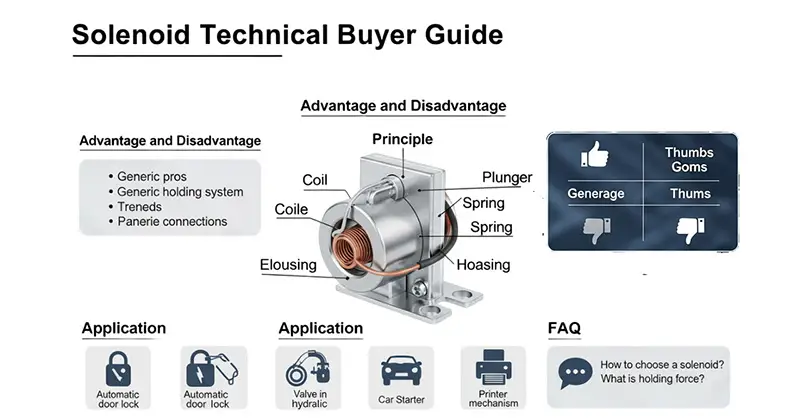
Chapter 4: The Type of electromagnets
An electromagnet is an electromagnetic component that creates a magnetic field by applying electric current through its wire coil. In contrast to permanent magnets, you can switch off an electromagnet at will. Also, you can change its magnetic force by regulating the amount of the current or changing the shape of the coil. The main applications of electromagnets are industrial automation, the automobile industry, medical devices, home appliances, and electronic devices. Depending on the structure, the way of action, and specific application, there are several varieties of electromagnets.
1. DC electromagnets.
DC electromagnets use direct current (DC) to generate a constant magnetic field. They are widely used as a part of solenoids, relays, door locks, and automated industrial equipment. One of the main advantages of DC electromagnets is their simple construction, fast response, and reliability.
Applications include:
door lock systems,
vending machines,
industrial control systems,
automobile actuators,
The force generated by a DC electromagnet depends on the number of windings in the coil, the value of current passing through the coil, and the core material.
2. AC electromagnets.
AC electromagnets are powered by alternating current (AC). The AC reverses the direction continuously, so the electromagnet’s magnetic field changes correspondingly. They are often applied in a number of applications, including transformers, contactors, and industrial systems.
Generally AC electromagnets have higher attraction forces compared with DC electromagnets. However, they may be prone to vibration and generate noise. To avoid overheating, the core is made up of a laminate of thin sheets of metal.
Applications are:
AC contactors,
industrial magnets,
electric bells, and
transformers.
3. Solenoid electromagnets.
A solenoid electromagnet is perhaps one of the most popular types of electromagnets. A solenoid is a combination of a wire coil and a moving plunger (or armature). By means of the current flowing through the coil, the plunger is forced to move.
The advantage of solenoids is their small size and fast response time. These electromagnets may have different types of construction: push solenoid, pull solenoid, and holding solenoid.
Main applications:
medical devices,
vending machines,
injectors (fuel injector),
electronic locks,
hydraulic and pneumatic valves.
4. Latching solenoids.
Latching solenoids are a particular case of an electromagnetic actuator. The peculiarity of latching solenoids is their ability to hold their position without applying current constantly. This is achieved by creating an additional permanent magnetic field.
The benefits of latching solenoids include reduced power consumption, stationary operation, lower temperature rise, and reliable switching.
Major applications:
smart meters,
electronic locks,
medical apparatus,
automotive,
remote control units.
5. Electric rotary magnet.
As opposed to a solenoid, an electromagnet is designed to perform rotational movement, not longitudinal. The electric rotary magnet converts electrical energy to the rotating magnetic field.
The benefit of an electric rotary magnet is rapid operation, reliable performance, and compact structure.
Typical fields of use:
camera systems,
office automation equipment,
machines of sorting in industry,
robotics.
6. Electromagnetic hoisting.
Hoisting electromagnets are strong electromagnets for lifting purposes. They are widely used in steel mills, the scrap metal industry, and warehouses. In addition, the material lifted is not required to be attracted.
The hoisting electromagnets are generally powered by DC to provide continuous magnetism. Once the power supply has been switched off, the material can be unloaded effortlessly.
The typical applications include:
scrap metals treatment,
steel plate transport,
crane systems,
metal sorting.
7. Electromagnetic hold.
Holding an electromagnet produces magnetic force to secure a door, fixture, or mechanical system. The major application is associated with security and automated control.
Examples include:
electromagnetic locks for doors,
fire doors,
clamping systems,
access control systems.
Chapter 5: Why Electromagnets Are Favored (What Buyers Look For)
1) Rapid Response – Typical switching time is 10–50 ms and is optimal for rapid actuation.
2) Simple Control—Functioning in both On/OFF modes using relays, transistors, or MCU outputs—without any external special
3) Compact, Yet Powerful – Packs a strong punch and is compact and useful.
4) High Reliability – A few moving parts result in a longer lifespan if correctly designed.
5) Cost—Compared to motors, gearboxes, and servo systems, relatively inexpensive.
6) Fail-Safe—In spring-return designs, reset happens automatically when power is lost.
Chapter 6: Drawbacks and Limits (Buyer Cautions)
1) Limited Stroke – 2 to 20 mm for typical motions.
2) High Instantaneous Power – The inrush current for energization may affect batteries or power supplies.
3) Heat Buildup—The energization could cause overheating in case it’s continuous and not properly controlled.
4) Fixed Force Profile – The force of pulling and pushing cannot be changed while operating.
5) Mechanical Noise – Contact between metal parts may make noise due to rebound.
Chapter 7. Common uses of an electromagnet
Industrial automation
Industrial
– Feeding mechanisms
– Sorting systems
– Locking and positioning devices
Cars
– Door locks
– Transmission control
– Head lamp shutters
Smart devices
– Intelligent door locks
– Vending Machines
– Attendance systems
Medical equipment
– Fluid control
– Diagnostic devices
– Safety interlocks
Office & Commercial Equipment
– Printers
– Copiers
– Currency counters
Chapter 8. An electromagnet Buyer Checklist (Key Selection Parameters)
Before purchasing a solenoid, you should:
– Rated voltage (DC or AC)
– Required push/pull force during working stroke
– Stroke length
– Duty cycle (intermittent OR continuous)
– Power consumption
– Ambient Temperature Range
– Expected service life (cycles)
– Noise and Vibration Limits
– Available installation space and mounting method
Chapter 9. FAQ – Frequently Asked Buyer Questions
Q1: How can I determine the required solenoid force?
Friction force between the bolts, weight of the load, force of the springs, and a safety factor (usually between 1.3 and
Q2: Is it possible for a solenoid to remain
Only continuous-duty solenoids can do that. Most typical solenoids must be pulse-driven.
Q3: What is the difference between push solenoids and pull solenoids?
In push solenoids, the solenoid forces the piston/plunger to move outward. In The next question is
Q4: Why might it work on the bench, but not in the product?
Causes: Voltage drop, mechanical misalignment, lack of force margin, or overheating.
Q5: Are latching solenoids preferable for battery-powered devices?
Yes. Latching solenoids remain in place without constantly being supplied with power.
Q6: What is the difference between solenoids and motors?
Solenoids allow linear on/off motion, while motors allow rotary motion with precise position control. Solenoid coils are usually made of copper, while motor coils
Q7: Electromagnets can be utilized in proportional control.
Yes, by pulse width modulation or current control, but most are intended for use as ON/OFF devices.
Q8: For how many years do solenoids usually last?
A period of 1 million to 100 million cycles, depending on quality, load, and conditions.
Q9: Why is my solenoid warming up?
It’s normal because of the coil resistance when it’s in continuous operation. Ensure that it can withstand your duty cycle.
Q10: Can an AC solenoid be driven with DC power (or vice versa)?
Usually not—they’re intended for use with a particular type of current. Wrong types can result in overheating or lack of force.
Chapter 10: How to Avoid Common Mistakes When Selecting an Electromagnet Product
Properly selecting an electromagnet is essential for ensuring good performance, longevity, and safety of automated machinery, medical tools, vending machines, automotive equipment, and smart machinery. Most customers tend to focus merely on voltage or magnetic holding force while ignoring technical features that play a significant role in reliable operation.
This guide outlines the ten most frequent electromagnet selection mistakes and how to avoid them.
1. Ignoring the Duty Cycle
Not considering the duty cycle is one of the most common purchasing mistakes.
An electromagnet suitable for intermittent use will heat up if energized continuously.
How to Avoid This Mistake
Clarify the electromagnet type:
Continuous duty (100% ED)
Intermittent duty
Pulse duty cycle
Verify required temperature rise.
Consider ambient temperatures.
Example
A 12V DC electromagnet operating continuously in automated machinery will fail due to overheating if selected for pulse operation only.
2. Choosing an Electromagnet According to Operating Voltage
Voltage alone is not enough to ensure proper operation.
Features to Consider When Selecting a Product
Current consumption
Resistance
Power
Heat rise
Magnetic force curve
Better Solution
Compare:
Operating voltage
Current draw
Required magnetic force
Stroke length
Operating frequency
3. Overlooking the Stroke Length
Changes in electromagnetic forces depending on the distance are enormous.
The magnetizing force at zero millimeters of air gap is significantly higher than at full stroke.
Common Mistake
Choosing a solenoid or electromagnet according to its maximum magnetic force.
How to Avoid This Mistake
Ask for:
Curve showing dependence of force on stroke length
Magnetic force at actual stroke length
Maximum holding force
4. Ignoring Environmental Conditions
Environmental conditions play a crucial role in determining performance.
Parameters That May Be Ignored
Dust
Humidity
Oil exposure
Corrosion
Outdoor usage
Vibrations
Better Solution
Choose:
Waterproof electromagnets
Encapsulated in epoxy resin
Corrosion-resistant construction
IP protection rating
5. Choosing the Incorrect Type of Electromagnet
Various types of electromagnets are used in particular applications.
Typical Types of Electromagnets
Open-frame electromagnet
Tubular electromagnet
Holding electromagnet
Rotating electromagnet
Latching electromagnet
Push-pull electromagnet
Recommended Electromagnet Choice
Choose electromagnet structure depending on application.
Rotary movement – rotary electromagnet
Linear movement – push-pull electromagnet
Long-term holding—holding electromagnet
Save energy – latching electromagnet
6. Ignoring the Need for Heat Dissipation
One of the primary reasons for electromagnet failure is overheating.
Problems Caused by Overheating
Coil insulation damage
Weakness of magnetic forces
Damage to electromagnet windings
Reduced lifespan of the electromagnet
Preventive Measures
Enhance airflow.
Limit electrification time.
Use low-power products.
Utilize temperature-resistant materials for coil winding.
7. Forgetting About the Required Response Time
Some automation systems need a fast response of electromagnets.
Common Mistake
Choosing a standard electromagnet for a high-speed system.
Better Electromagnet Choice
Take into account:
Response time
Releasing time
Residual magnetism
Spring return force
Application Examples
In sorting systems, medical pumps, packaging machinery, and precision automation.
8. Not Taking Residual Magnetism into Account
A residual magnetic field prevents the electromagnet from releasing after being switched off.
Potential Problems
Mechanical locking
Slow-release process
Incorrect positioning
Product jams
Solutions
Utilize materials that do not generate residual magnetic fields
Add air gaps
Optimize magnetic circuit design
Apply demagnetization techniques
9. Not Considering Mounting Dimensions
Inappropriate mounting size is among the most widespread electromagnet purchase mistakes.
Before Buying an Electromagnet
Make sure you consider:
Overall dimensions
Mounting hole size
Direction of stroke
Location of terminals
Space restrictions
Recommended Approach
Request:
2D diagrams
3D CAD models
Mounting dimensions
10. Ignoring Requirements Related to Life Cycle
Every electromagnet model has its lifetime.
Questions Worth Asking
Cycle frequency per day?
Operating life in years?
Load conditions?
Switching frequency?
Better Solution
Choose:
Products that are verified for millions of cycles.
Durability.
Consistent force output performance.
Chapter 11. Troubleshooting Guide (Common Buyer Problems & Solutions) 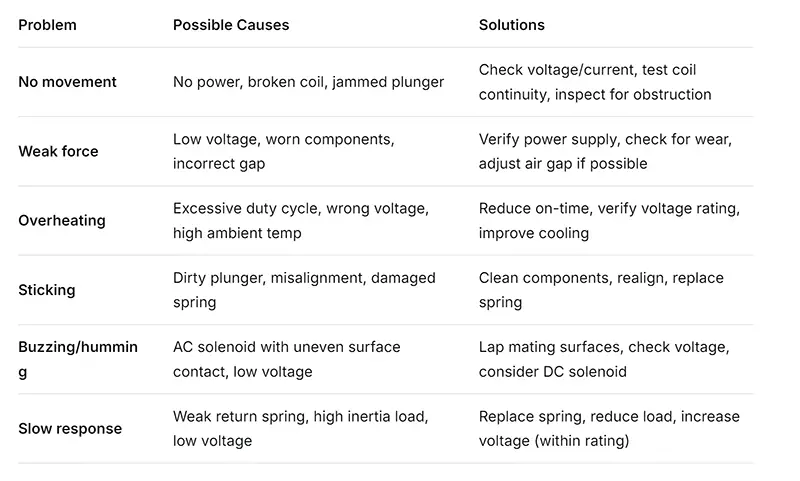
Chapter 11. Maintenance Advice
– The plunger hole needs to be kept clean and lubricated if recommended by the manufacturer.
– Check the mounting bolts periodically for tightness.
– Check any electrical connections present for corrosion.
– Operation under load. – Test regularly.
– Repair or replace the parts if there is physical damage or if the resistance values of the coils vary considerably.
Chapter 12: Final Buyer Guide Summary
Electromagnets can resemble a very simple electromechanical component; however, the improper selection of the solenoid may lead to serious difficulties in the system and danger to users of the system, as well as substantial maintenance costs post-production or sale of the system. A comprehensive solenoid buyer’s guard process would include the following:
– A good understanding of the workings of the solenoid as well as the components inside the device
– Matching of force, stroke, and rating voltage to suit required operations
– Correct design for Duty Cycle, Power Consumption, and heat; an assessment of performance under actual working and environmental conditions
– Fail-safe planning for future use
This Solenoid Buyer Guard keeps the buyer and the engineer safe from the risks associated with projects and ensures stable performance and smooth running. Solenoids work well as actuators of linear motion and are very versatile and economical. Once the rules and requirements are known and understood, the chosen solenoid will work with reliability and vibrations.
It is necessary to check the specifications and requirements of the solenoid and the environmental factors like temperature and humidity. Important Reminder: If there’s uncertainty about the selection or design, you can refer to Weilong Manufacturer’s technical support at [email protected]. Our engineering team can provide design-specific guidance to help maximize reliability.
