

Chapter 1: An Introduction to Solenoid Duty Cycles
When our customers start a new solenoid project, they rarely know how a solenoid operates and the impact of working conditions on the performance of the product. Duty cycle is one of the most misunderstood specs. In many cases, the duty cycle is overlooked when choosing a product, while it is a critical component of magnetic force, speed, power usage, heating up, reliability, and solenoid life span.
As a professional solenoid manufacturer, we receive many inquiries from engineers such as
What is a duty cycle of a solenoid
Impact of duty cycle on magnetic force
Can a solenoid run continuously?
What is the influence of duty cycle on heating up?
What is duty cycle calculation?
In this article, I explain the relationship between solenoid duty cycle and performance characteristics and solenoid lifespan to help engineers choose the right solenoid.
Chapter 2: What is Solenoid Duty Cycle?
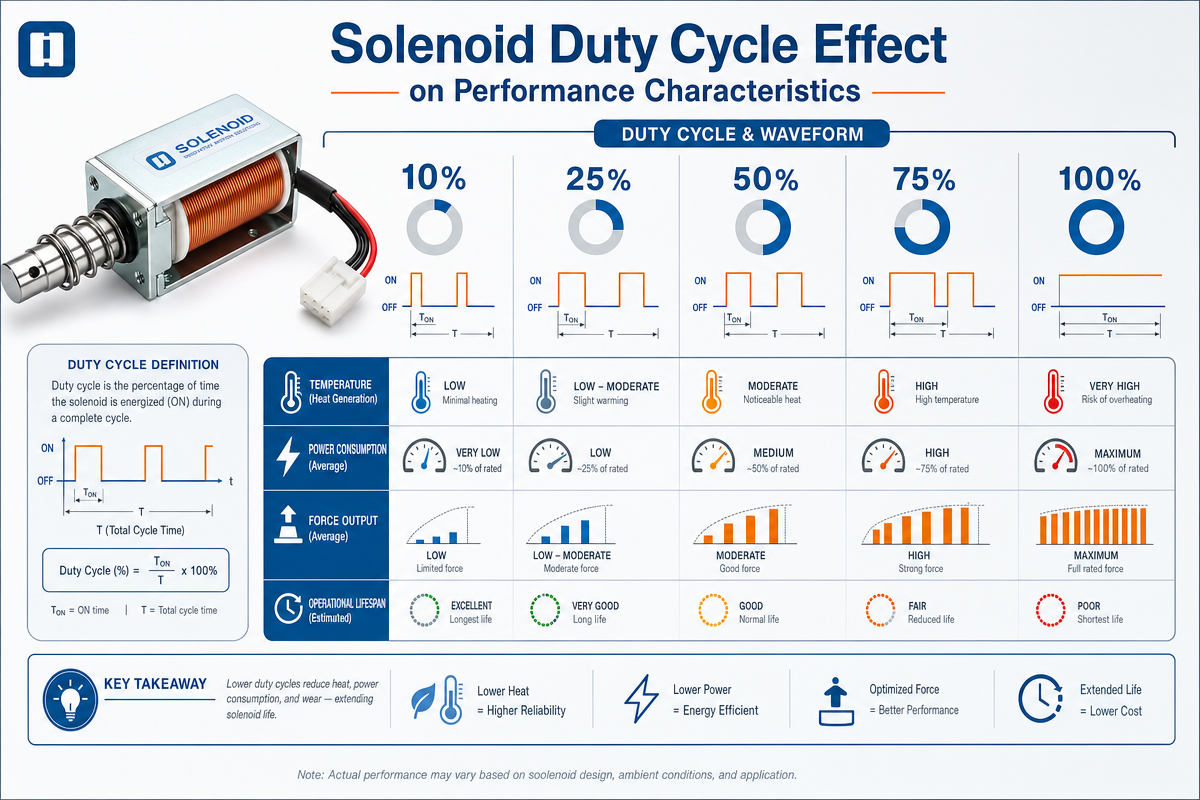
A solenoid’s duty cycle is the percentage of the period that a solenoid operates.
That is: 100% Duty Cycle: Operates Continuously
50% Duty Cycle: ON for Half Time
25% Duty Cycle: ON 25%
Solenoid duty cycle plays an essential role in determining how much heat builds up since the higher the duty cycle, the greater the buildup of heat in the coil. The basic formula of calculating duty cycle is given as
Duty Cycle = Ton/(Ton + Toff) * 100%
Where: Ton = Time energized
Toff = Time off energized
E.g., energized for 15 seconds
45 sec break
Duty Cycle=15/(15+45)x100%
=25% That means the solenoid runs under a 25% duty cycle.
Chapter 3: Solenoid duty cycle effect on performance characteristics
3.1 Magnetic Force
Solenoid duty cycle has a major influence on the creation of magnetic forces.
The higher the duty cycle, the greater the amount of continuous current. The solenoid must generate and maintain sufficient magnetic energy while maintaining safe working temperatures.
When current flows through the coil
A magnetic field develops
Magnetic Flux grows
The plunger is driven
Work performed
Solenoids that operate with a higher duty cycle normally include the following:
Larger copper coil
Low current density
Good heat dissipation
“Thicker insulation systems”
These attributes guarantee the stability of magnetic force over a long period of time.
Example
A solenoid that runs at a 10% duty cycle can generate extremely high magnetic force for short periods.
A solenoid operating at 100% duty cycle usually generates less peak magnetic force but can maintain magnetic force for continuous time without overheating.
Engineers must consider
Magnetic force requirement
Size of the coil
Energy consumption
Duty Cycle Spec
3.2 Speed of Response
The solenoid duty cycle also controls the rate of response of the solenoid.
Response time is the amount of time it takes for the plunger to react when electric voltage is supplied to it.
Fast-response applications include the following:
Packaging Machines
Medical Devices
Automatic sorting machines
Industry Automation
Automotive Actuators
Properly designing the duty cycle allows fast buildup of magnetic fields, hence faster actuations.
Benefits
Greater Switching Speed
Increased efficiency
Improved control accuracy
Improves system reliability
Too much of a current increase to facilitate a fast response might lead to excess heat buildup on the coil.
Therefore, it’s upon the engineer to optimize the duty cycle and operating current.
3.3 Accuracy of Position
There are many applications where the solenoid is required to operate at precise positions.
For instance,
Valve Control Units
Locking Devices
Automation Equipment Precision Applications
Laboratory Equipment
The produced magnetic force determines how accurately the plunger reaches the required destination.
Optimal design of the duty cycle allows
Magnetic Force Stability
Constant Motion
Minimal Shakes
Improved Repeatability
If the solenoid duty cycle is improperly chosen, then the increased heating will raise the resistance of the coil, leading to reduced magnetic force and hence poor positioning accuracy.
Chapter 4: Solenoid Duty Cycles And Their Effects On Longevity
Though performance is important, lifespan is the key factor that matters most when using a solenoid industrially. There are three major factors that affect the life expectancy of the solenoid:
Heat.
Wear (mechanical).
Electrical Stress
4.1 Heating Up and Temperature Rise
Heating up is the main factor that influences the lifespan of a solenoid.
Whenever there is an electric current flowing through a coil, power is converted to heat.
The relationship between heating up and temperature rise is shown by the following:
P = I²R
Where:
P = Energy loss
I = Present Electric Current
R = Coil Resistance
With increasing duty cycle
Electric Current becomes active for a longer period
Increases in average current
Heat increase
A solenoid operating at a 100% duty cycle is always energized and therefore has the highest temperature rise.
Some of the effects of overheating include
Insulation Breakdown
Decrease in magnetic Efficiency
Wire Deterioration
Premature Failure
Most of the failures occurring due to solenoids happen because of overheating.
4.2 Mechanical Wear
With each actuation of the solenoid, there is internal motion.
The repeated hitting of the plunger against
Guidance tube
Spring;
Bearings
stops
Mechanical Transmission.
Causes mechanical wear through friction.
Some of the high-duty cycle applications include the following:
Higher switch frequency
Piston Movement Increased
Increase in mechanical strain
The effects of wear accumulation include:
Consistency in Stroke Reduced
Output Force Reduction
Noise Generation Increased
Increased Risk Of Failure
Some ways to reduce wear include proper lubrication, proper selection of materials, and maintenance.
4.3 Electrical Stress
One more factor influencing the lifespan of a solenoid is electrical stress.
Causes of Frequent Switching
Voltage Surges
Arcing Contacts
Electromagnetic Interference
Coil Stress
Due to the increased frequency of switching, there is an increased level of electrical stress.
The outcomes could be
Contact Corrosion
Relay Breakdown
Driver Circuit Failure
Wire Deterioration
Engineers normally incorporate the following to reduce electrical stress:
Flyback Diodes
Surge Protectors
PWM Controllers
Snubber Circuits.
Chapter 5: Relationship Between Duty Cycle And Power Usage
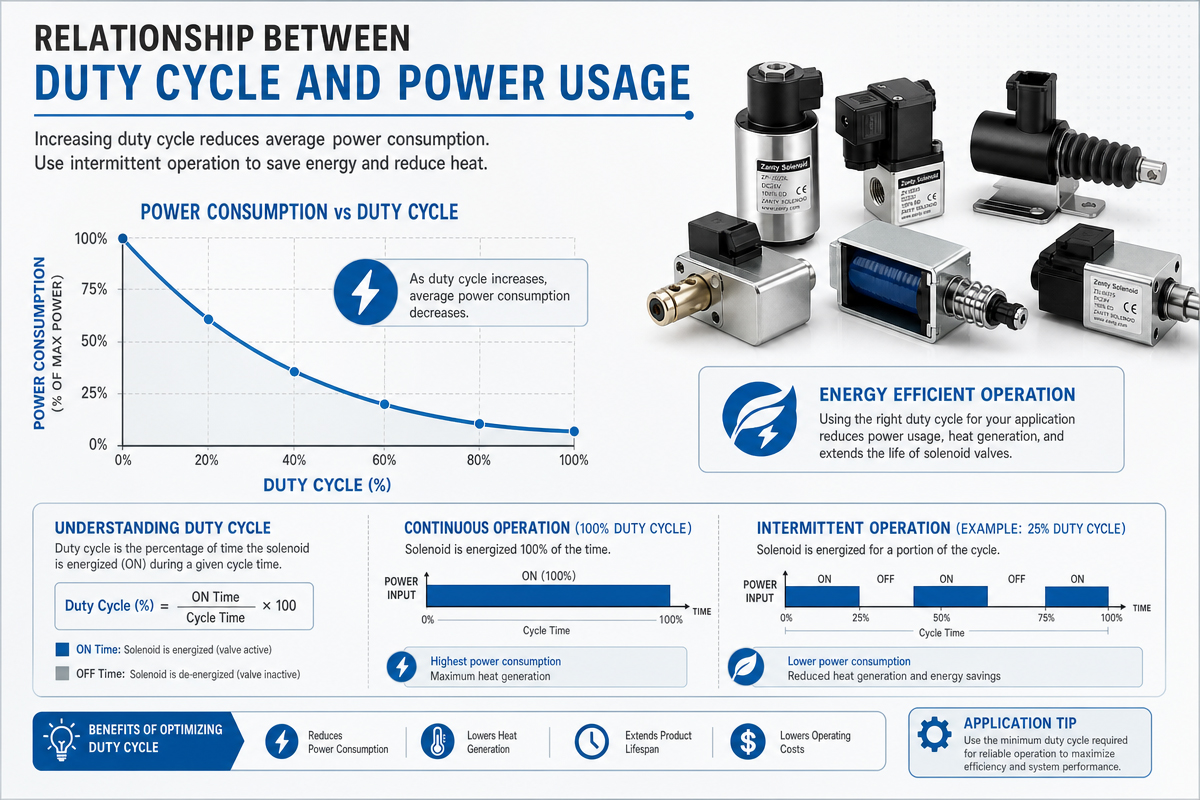
Power usage is directly proportional to the duty cycle.
Power consumption of a solenoid, on average, can be determined as follows:
Pavg = Prated × Duty Cycle
Assuming voltage and resistance to be constant:
Duty cycle doubling nearly doubles the power usage
Duty cycle reduction lowers power usage
E.g.
Suppose there is.
The solenoid power rating is 20W
Power Consumption
Duty Cycle 25% -> 5W
Duty Cycle 50%-> 10W
Duty Cycle 100%-> 20W
Therefore, optimization of the duty cycle helps save on cost for systems utilizing batteries.
Chapter 6: Current, Duty Cycle, and Heating Up
Current flow and heating up go hand-in-hand.
Increasing duty cycle leads to the following:
Longer Time Active Current
Increased Coil Temperature
More Energy Usage
That explains why a continuously energized solenoid heats up during operation.
If the heating level is beyond the set limits, you would face some of the following:
Insulation Damage
Coil Burnout
Magnetic Force Reduction
Electronic Component Damage.
However, lowering the duty cycle provides the following:
Temperature Level Reduced
Less Power Used
Increased Lifespan
Reliability
Most industrial solenoids are designed for intermittent duty rather than continuous operations.
Chapter 7: How to Determine Solenoid Duty Cycle
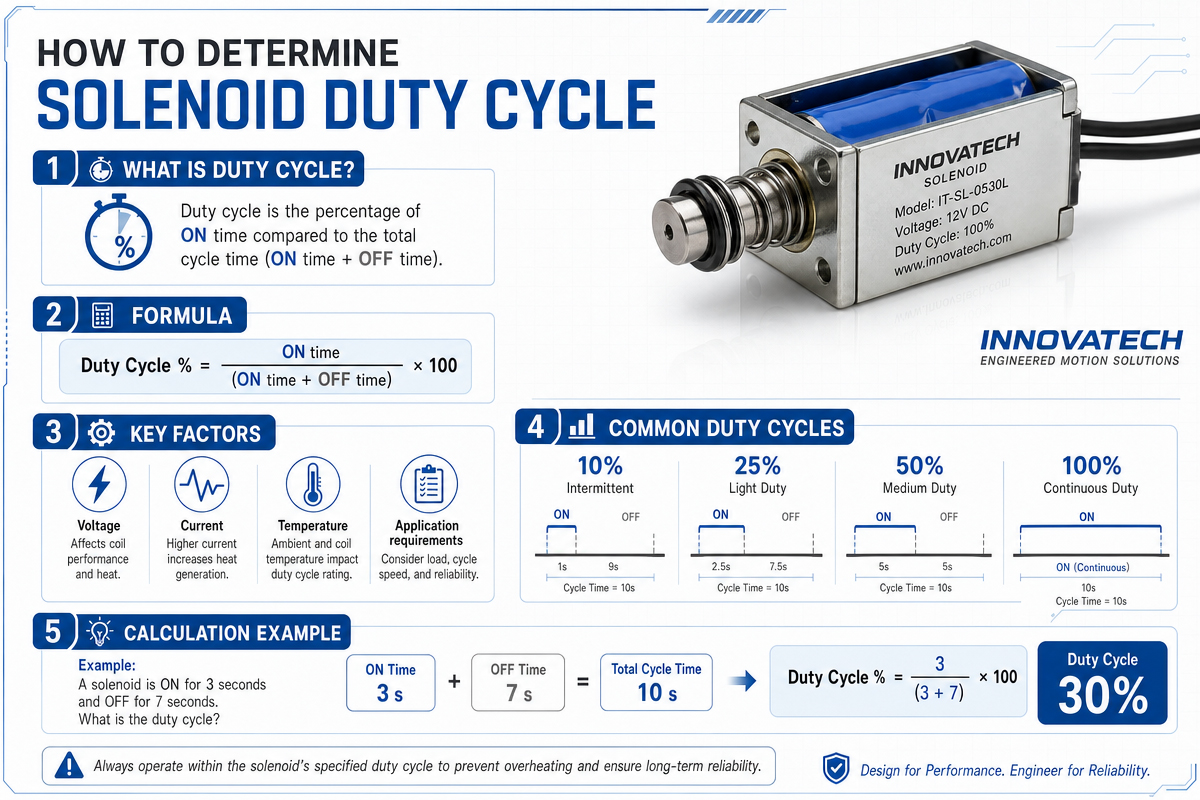
It is pretty simple calculating the solenoid duty cycle.
Example 1.
ON time = 2 minutes
OFF Time = 20 sec
Duty Cycle Calculation:
(120/(120 + 120)) ×100
= 50%
Therefore, Duty Cycle = 50%
Example 2
ON time = 2 minutes
Desired Duty Cycle = 60%
Finding OFF time
Use:
60 = 100 x 120 / (120 + T)
Solving for T
T = 80 sec
Hence,
ON time = 120 sec
OFF Time = 80 sec
Duty Cycle = 0.6
Solenoid Standard Duty Cycles Ratings
Common industrial duty cycle ratings are
Duty cycle Application
Short Pulse Operation: 10%
25% Intermittent switching
50% Typical operation
75% Typical Operation
100% Continuous Operation
Industrial solenoids are rated to work in a duty cycle ranging from 10% to 100%, including
Solenoid Push-Pull
Open Frame Solenoids
Tubular Solenoids
Rotary Solenoids
Solenoid Latch
Automotive Solenoid
Solenoid Valve
Retaining Electromagnets
Chapter 8: Altering the duty cycle of a solenoid?
Yes, there are several ways in which the duty cycle can be altered.
8.1. PWM Control
One of the most popular control methods is pulse width modulation (PWM).
PWM control:
Mean current
Output power
Coil Temperature
Advantages:
Consumes less power
Reduces heating
More energy-efficient—
Longer lifespan
PWM is very popular in automation technologies.
8.2. Adjusting Operating Frequency
Duty cycle may also be influenced by operating frequency changes.
With changes in frequency:
Changes in the duration of each cycle
Changes in energizing time
Changes in average power
Calculation must be done with care so as not to burn out the device.
8.3. Current adjustment
Current adjustment impacts:
Magnetic field intensity
Increase in temperature
Capacity for further duty cycle.
A lower current will generally result in:
Lower temperature increase.
Lower power consumption
Increased Service Life
Chapter 9: Practical Guidelines For application of Solenoid duty cycle
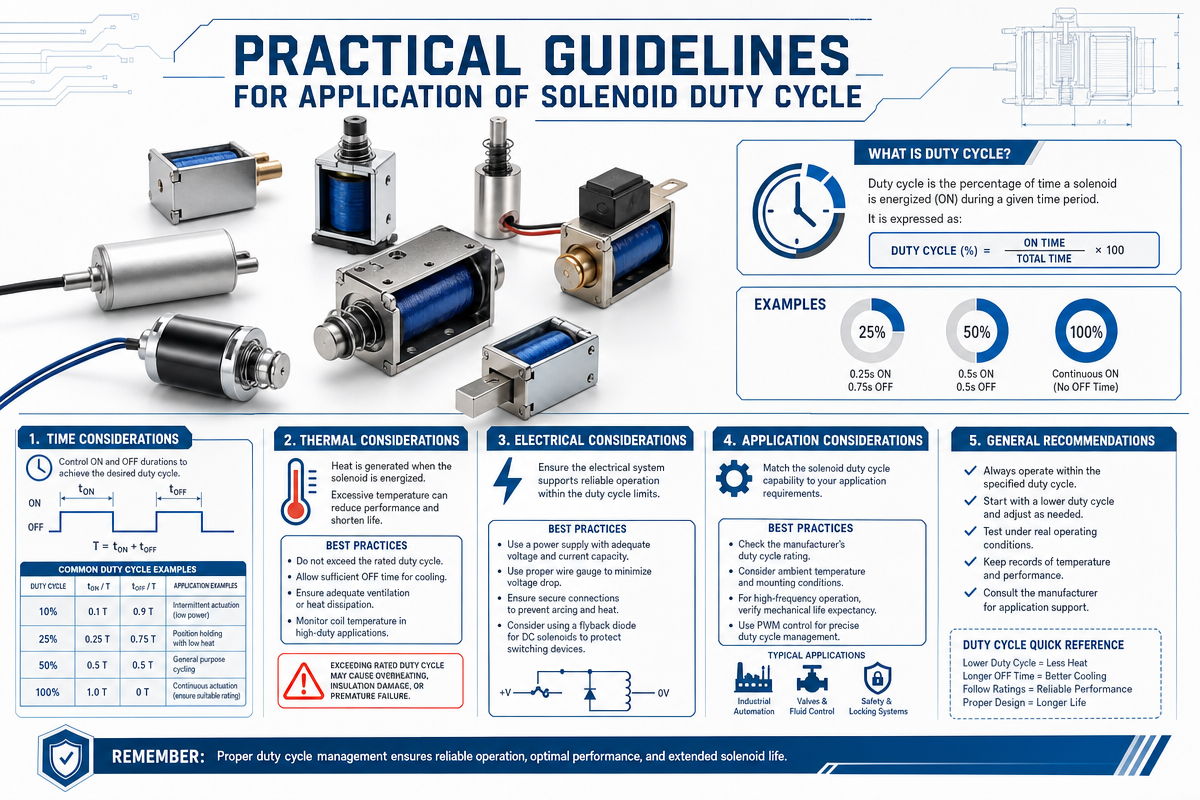
9.1 Monitoring the temperature increase
Monitoring the temperature is crucial
Recommended measuring tools:
Infrared thermometer
9.2 Heat sensors
Different Types of Temperature Sensors
High temperature means high duty cycle.
Monitoring the response time
Engineers use oscilloscopes for measuring:
Ignition time
9.3 Shut-off time
Wave shapes of current
The efficiency will be increased with precise measurements.
Testing Under Real-World Conditions
Laboratory conditions do not reflect the real-world environment.
Thoughts:
Temperature (ambient)
Air Flow
Conditions of operation
Frequency of Operation
Duty cycle ratings are normally done on
35°C Ambient
Rated operating voltage DC
Under Standard Testing Conditions
Derating may be needed under some real-world conditions.
Practical Tips For The Choice of Solenoid Duty Cycles
For selecting a solenoid, consider the following: the following:
Choosing 100% duty cycle if:
Continuous holding force
Long-term energization is required.
Reliability is crucial
Select Lower Duty Cycles When:
Needs high force shortly
Energy efficiency is important
Fast actuation
Always Consider:
Environmental temperature
Coil voltage
Supply power
9.4 Temperature limitations.
Mechanical cycle requirements
Correct selection prevents service life losses due to overheating.
Chapter 10 : Frequently Asked Questions On Solenoid Duty Cycles
Q1. What Happens If You Drive A Solenoid Above Its Duty Cycle Rating?
When a solenoid is driven beyond its duty cycle rating, it will start heating up due to heat accumulation in the coil.
Consequences:
Overheating of the coil
Insulation Breakdown
Weakening of magnetic force
Increased energy consumption
Failure
Loss of service life
For instance, if a solenoid rated with a 25% duty cycle is driven with a 100% duty cycle, it may result in all of the above-mentioned consequences.
Q2. 100% Duty Cycle Solenoid vs. 25% Duty Cycle Solenoid: Is It Better?
No. The 100% duty cycle solenoid is designed for continuous operation and can be energized for a prolonged time. However, the peak force generated will be relatively low compared to an equivalent-sized intermittent-duty-cycle solenoid.
For example, the intermittent duty cycle solenoid of 25% will produce more peak force due to the fact that it has enough time to cool down.
Selection will depend on the requirements of the particular application.
Q3. What Are The Effects Of Duty Cycle on Solenoid Magnetic Forces?
The duty cycle limits maximum power and current consumption of the coil.
Typically:
Lowest duty cycle, lowest peak force
Highest duty cycle—highest force but generates more heat and requires continuous operation capability
Most manufacturers design intermittent duty solenoids for higher current density in order to develop more magnetic force.
Q4. What is the relationship between solenoid temperature and duty cycle?
The longer you energize the solenoid, the more heat is generated in the coil.
Variables That Influence the Coil Heating Rate:
Applied Voltage
Resistance of Coil
Environmental Temperature
Duty Cycle (%)
Ventilation
A higher duty cycle will increase average power and, hence, operating temperature.
Q5. What is the difference between continuous-duty solenoids and intermittent-duty solenoids?
Feature: Continuous Duty Solenoid Intermittent Duty Solenoid
Duty Cycle: 100%, 10% – 75%
Operational Time Continuous Periodically
Temperature Rise: Lower, Higher
Peak Force: Medium, High
Power Consumption: Continuous/Intermittent
Applications: Actuation, Switching, Holding, Locking
Intermittent duty solenoids are widely used in locking mechanisms, while continuous duty solenoids are utilized in moving applications.
Q6. Is there an option to convert an intermittent duty solenoid to continuous duty?
No. The intermittent duty solenoids have coils designed for operation at a duty cycle lower than 100%. Thus, they will likely overheat when energized constantly.
The following modifications are usually required for making the solenoid capable of continuous-duty operation:
Coil winding design
Wire diameter
Number of Turns
Insulation Class
Heat Dissipating Structure
If continuous operation is required, then the 100% duty cycle solenoid must be selected at the design stage.
Q7. Does PWM affect the duty cycle?
Yes. Pulse Width Modulation (PWM) is a typical method to control the effective duty cycle and, hence, the average current of a solenoid.
Advantages:
Heating Reduced
Less Power Consumption
Increased Efficiency
Extended Service Life
Enhanced Force Control Capability
PWM is widely employed in automotive, automation, electronic locks, etc.
Q8. Recommended Solenoid Duty Cycles For Industrial Solenoids?
Duty cycle depends on the particular application.
Recommendations for typical applications:
10%–25%: Short stroke, high force applications
25%-50%: Automation In General
50%–75%: Frequent Operations Systems
100%: Continuous Holding and Locking applications
Always look at the duty cycle specified by a manufacturer before purchase.
Q9. Effect of environmental temperature on Solenoid duty cycle
The standard ratings are based on temperatures around 35°C.
If the temperature is above this point, it means the following:
Increased rate of heating
Poorer cooling ability
Possibility to lower the duty cycle
In cases of higher temperatures, engineers typically go for bigger coils or higher-temperature insulation classes.
Q10. How to extend solenoid service life?
For increasing the life of the solenoid:
✔ Selection of the correct duty cycle
Preventing coil overheating
Applying PWM current reduction
Providing Good Ventilation
Install Flyback Diode
Reduction in high switching frequency
Periodic Maintenance
Following these recommendations will significantly increase solenoid reliability.
Chapter 11 : Conclusion
Duty cycle in solenoids is one of the most important factors that should be considered when designing and using the actuators. Among other benefits, a higher duty cycle means increased time during which solenoids work without stopping and higher energy consumption; on the contrary, lower solenoid duty cycles mean less heat generation and smaller power consumption, which will contribute to prolonged working hours without any negative effects.
In turn, knowledge about different duty cycles in solenoids allows engineers and producers to choose and implement the best possible solution in terms of solenoid performance, efficiency, durability, and many other parameters that are important in various industries such as industrial automation, automotive systems, medical devices, security products, electronics, and others.
It is necessary to have information about duty cycles in solenoids because only in this way will we be able to select actuators that will operate efficiently and provide required performance and efficiency levels during many years of work without breakdowns and malfunctions. Whether you need push-pull solenoids, open-frame solenoids, tubular solenoids, rotary solenoids, latching solenoids, solenoid valves, or holding electromagnets, you need to know about their duty cycles.
