

Chapter 1 : Introduction to Magnetic Soft Materials
As essential components of electrical apparatus and electromagnetic systems in electrical engineering and automation, industrial manufacturing, communication electronics, and energy systems, soft magnetic materials play a decisive role in determining the quality, capacity, power efficiency, and performance of electromagnetic apparatus. Engineers have long paid much attention to voltage, coil power, force generation, or structural dimension while developing electromagnetic devices from small relays to big industrial motors, solenoids, and electromagnetic chucks.
Nevertheless, there is always a key factor – soft magnetic materials which will decide the real performance and efficiency of an electromagnet device. Good choice will help you optimize the magnetic induction performance, improve the magnetic conduction efficiency, increase reaction speed and extend service life; but inappropriate selection will result in excessive heat generation, high residual magnetism, eddy current loss and decreased reliability.
In this guide, you can find comprehensive information about some common magnetic soft materials, working principles, classifications, pros, cons, applications, and developmental trends in the future.
Chapter 2 : What Are Magnetic Soft Materials
Magnetic soft materials are particular ferromagnetic materials used in the application fields of electromagnetic induction and magnetic conduction. The major features of them are:
High magnetic permeability
Low coercivity
Low hysteresis loss
Easily magnetized and demagnetized
Very low residual magnetism
Unlike permanent magnetic materials, soft magnetic materials lose most of the magnetism with the removal of the external magnetic field. Therefore, these materials can help your electromagnetic equipment work efficiently, economically, and with rapid responsiveness.
Due to these properties, magnetic soft materials are broadly used in the following areas:
Electromagnet
Transformer (2007)
Electric motor
Relay
Choke
Solenoid Valve
Wireless Charging System
High Frequency Electronic equipment
Chapter 3: Main Types of Magnetic Soft Materials
According to composition, producing process and operation frequency, there are mainly four types of soft magnetic materials:
Iron and Steel Materials
Silicon Steel
High Permeability Alloys (Permalloy)
High Frequency Soft Magnetic Materials (Ferrites)
These kinds of materials each have their own advantages and features for specific application of electromagnetics.
3.1 Soft Magnetic Materials: Steels and Pure Iron
Steel and pure iron are commonly used as magnetic soft materials for industrial electromagnets.
Examples of soft magnetic steels and iron include:
Electrolytic Iron
Iron (carbonyl).
Pure iron engineering.
Low carbon steels
Properties of iron and steel
Magnetic Saturation: High
Magnetic Conductance: Good
Good Mechanical Strength
*Machining easy
Cost-effective
Unfortunately, because of low resistivity, these materials cannot be applied in high-frequency alternating magnetic fields.
Uses
DC and low frequency applications. Only steel and pure iron are generally used.
Electromagnetic chuck, industrial
Electromagnetic DC
Electromagnetic brakes:
contactors dc
Solenoid Actuators
Low voltage switching
Even today, pure iron is still the most economical and effective magnetic core material for stable DC magnetic circuitry.
3.2 Silicon Steel:
Dominant Electromagnetic Cores Material Silicon steel is the most popular soft magnetic material in transformers, motors, and AC electromagnets.
Produced through alloying of silicon in the iron to around 0.8% -4%, Silicon steel is an excellent soft magnetic material owing to the following reasons:
Increased resistivity.
Reduced Eddy Current loss.
Hysteresis loss reduction
Tuning of magnetic permeability
Prevention of magnetic aging
To further reduce the heat loss caused by eddy currents, silicon steel cores are commonly laminated.
Advantages of silicon steel
Most notable advantages include:
Efficient magnetic performance
Minimum Energy Loss
Exquisite thermal stability
Excellent AC performance
Mass-production at affordable costs
Low Silicon Steel vs High Silicon Steel
Low silicon steel: Improved mechanical toughness Is Suitable for:
Motors
Industrial relays
servomotors
Silicon Steel, high
Less magnetic loss and enhanced performance is suited for:
Transformers
Voltage regulator
Electrostatic Apparatus
Precise electrical systems
Hot-Rolled Silicon Steel vs Cold-Rolled Silicon Steel (CR)
Hot Rolled Silicon Steel:
Traditional industrial materials, cheaper
Cold Rolled Silicon Steel (CR)
High Precision
More magnetic precision
Fewer Losses
Used in high precision industrial equipment
Also cold rolled silicon steel exhibits magnetic anisotropy, that means the magnetic performance is highly dependent on rolling direction.
3.3 Permalloy: High Permeability Soft Magnetic Materials
Permalloy is nickel iron alloy with high permeability suitable for precise detection in a weak magnetic field.
Usually, the composition includes:
36 to 80 percent nickel
Ferrous
Molybdenum
Or other alloying elements
Classic Composition
Approximately 78.5% Ni,
21.5% ferrous
Properties
Very high magnetic permeability
Good Weak Field Detection Performance
High Sensitivity
Electromagnetic conversion efficiency
Disadvantages
Permalloy, despite its high sensitivity, has certain shortcomings:
Low mechanical strength
Expensive material
Low Resistivity
Difficult to apply in high frequency operation
Sensitive to vibrations and stresses.
Magnetic performance will seriously decline after deformation.
Applications
Common uses are:
Relays Precise
Instrument Transformer
Magnifying amplifiers
Signal Detectors
Core of sensor
Communication electronics
This is a high-performance material for precise low voltage electromagnetic equipment.
Chapter 4: High Frequency Soft Magnetic Materials
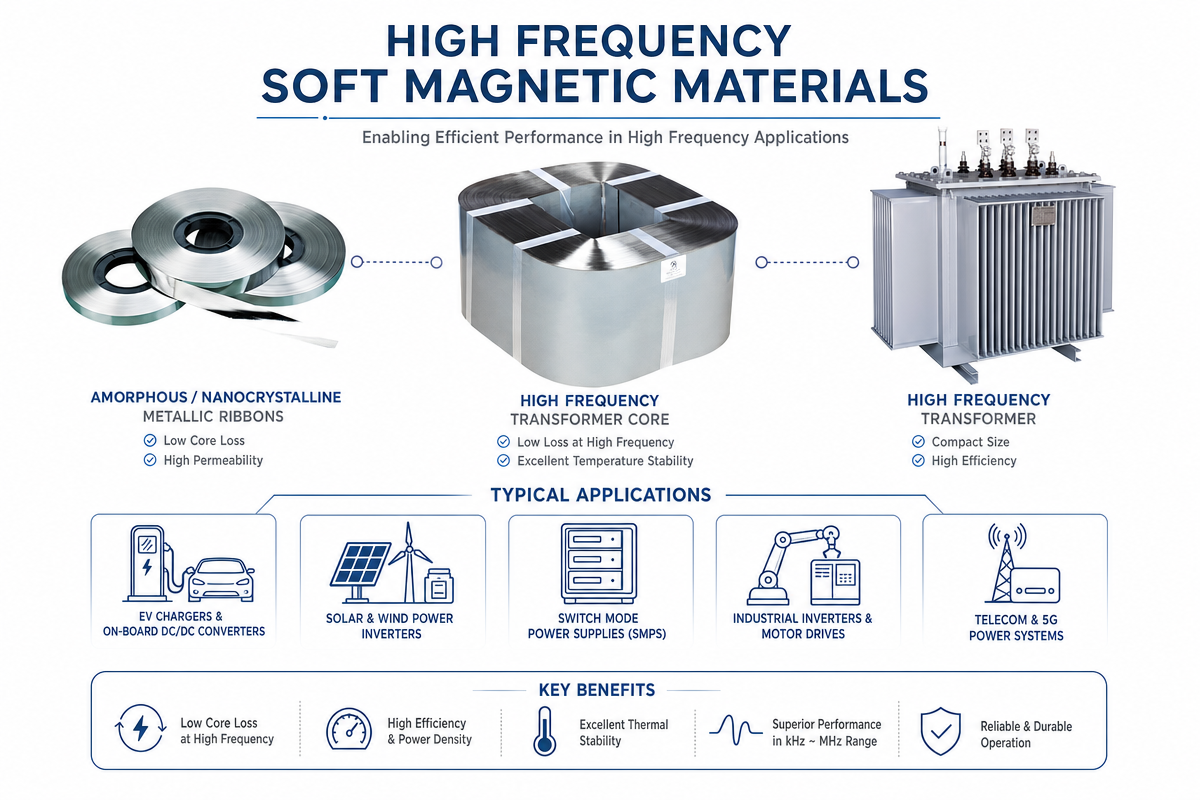
Ferrite High frequency electronics rely on ferrite as the main magnetic soft materials for high-frequency operation.
As a semiconductor material, ferrite has extremely high resistivity which can greatly reduce the loss in high frequency.
Made through ceramic sintering method including:
Iron oxide (Fe₂O₃)
Dioxide of manganese
zinc oxide
nickel dioxide
Popular Ferrite Materials
Mainly zinc manganese ferrite
Nickel zinc ferrite
Main Features
Great high frequency features are:
Very low high frequency loss
Good EMI rejection
Excellent high frequency stability
Very light weight
Good electrical insulation.
Application
Popular application are:
Power Supplies
Wireless charging
High frequency transformers
5G Communication Device
EMI Ring
High Frequency Inductor
For today’s modern digital electronic and communication system
Chapter 5: Ferromagnetic Law of Soft Magnetic Materials
Ferromagnetism is based on two internal factors of the material, that is, internal crystal structure and magnetic domain.
Ferromagnetic materials have numerous microscopic magnetic domains existing naturally. In case of no external magnetic field, the orientation of the domains is random and the effect cancels out each other.
The strong magnetization happens when all magnetic domains get aligned in the same direction because of an external magnetic field. Soft magnetic materials return to their demagnetized condition with slight residual magnetism once the external field is off. That is the reason why soft magnetic materials are ideal for making electromagnets.
Chapter 6: Selection of Soft Magnetic Materials
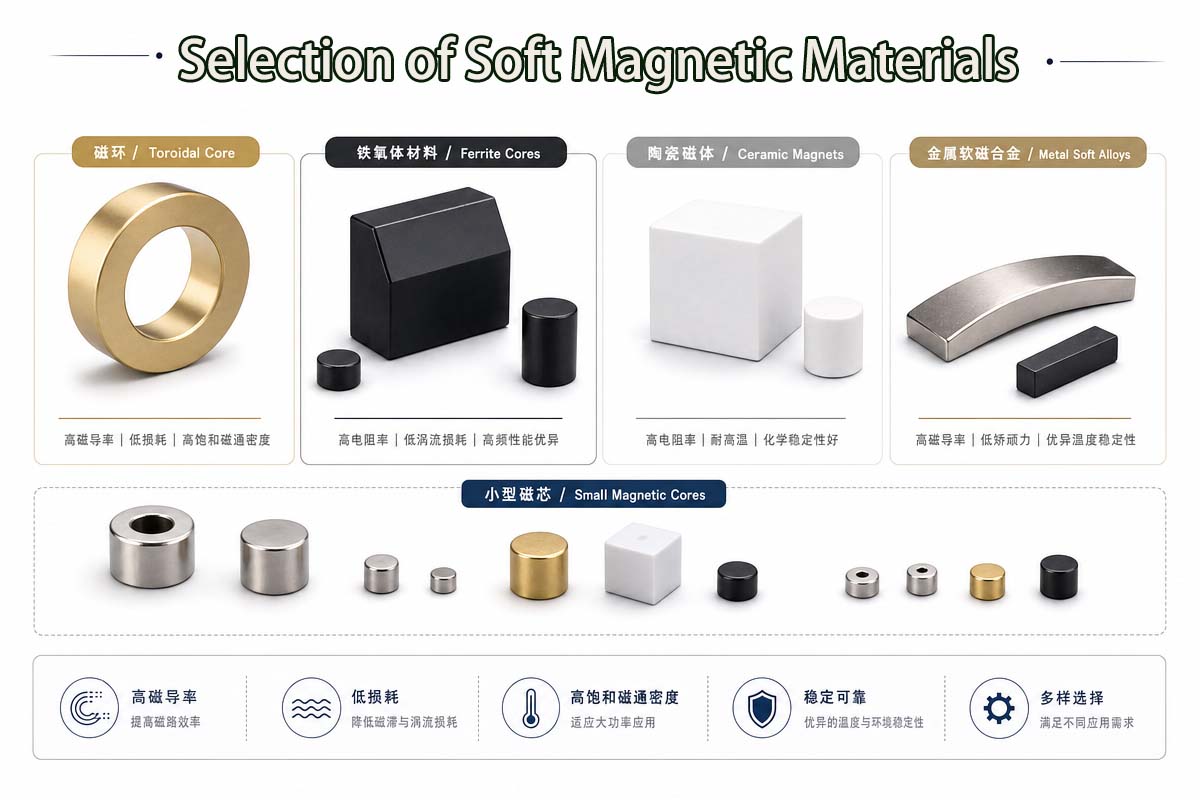
Choosing the right soft magnetic material will be largely determined by a series of factors:
6.1 Operation Frequency
→Pure iron and steel: Uses in DC operation
→Silicon steel: AC operation at power frequency
→High-frequency electronics: Ferrite Materials
→Weak Signal System: Permalloy
6.2 Mechanical Environment
Exclude any possibility of using stress-sensitive materials such as Permalloy in vibration environments.
6.3 Temperature Environment
High temperature system: Stable magnetic performance and minimum temperature coefficient
6.4 Energy Efficiency Requirements
Low Loss Silicon Steel and Advanced Nano Crystal
6.5 Production And Cost Consideration
Selection criteria:
Performance of the system
Difficulty in Processing
Production costs
Long Life Expectancy
Chapter 7 : Common Errors in Magnetic Soft Material Selection
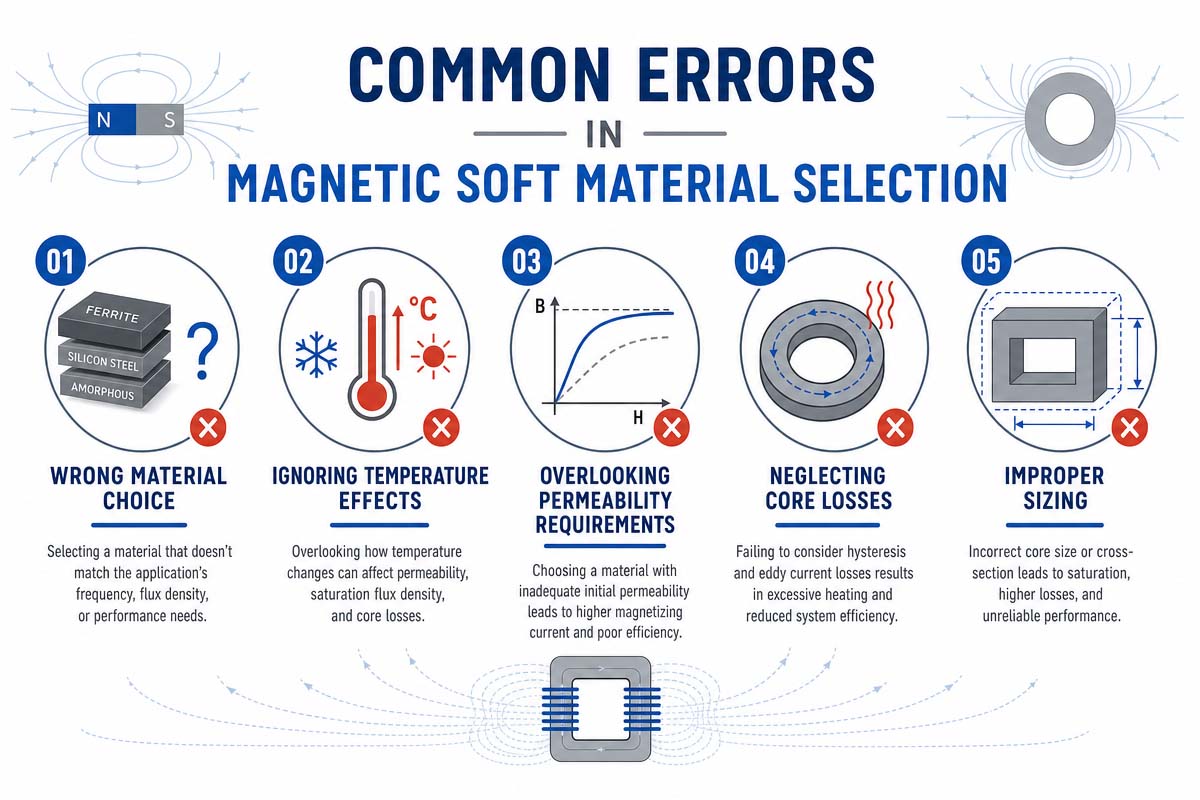
There are many cases of failure caused by wrong selection of materials.
Substitute Silicon Steel with Ordinary Steel
Will lead to:
High Heating
High power usage
Low Efficiency
Insulation damage
Using Ferrite at Low frequency and high power equipment
Ferrite will quickly saturate in such conditions.
Failure to Consider the Effect of Magnetic Direction
Cold rolled silicon steel should be fixed at a proper rolling direction.
Purchasing Sub-standard Materials
Substandard materials might contain incorrect alloy content or inconsistent magnetic performances.
Chapter 8 Future Trend in Soft Magnetic Materials
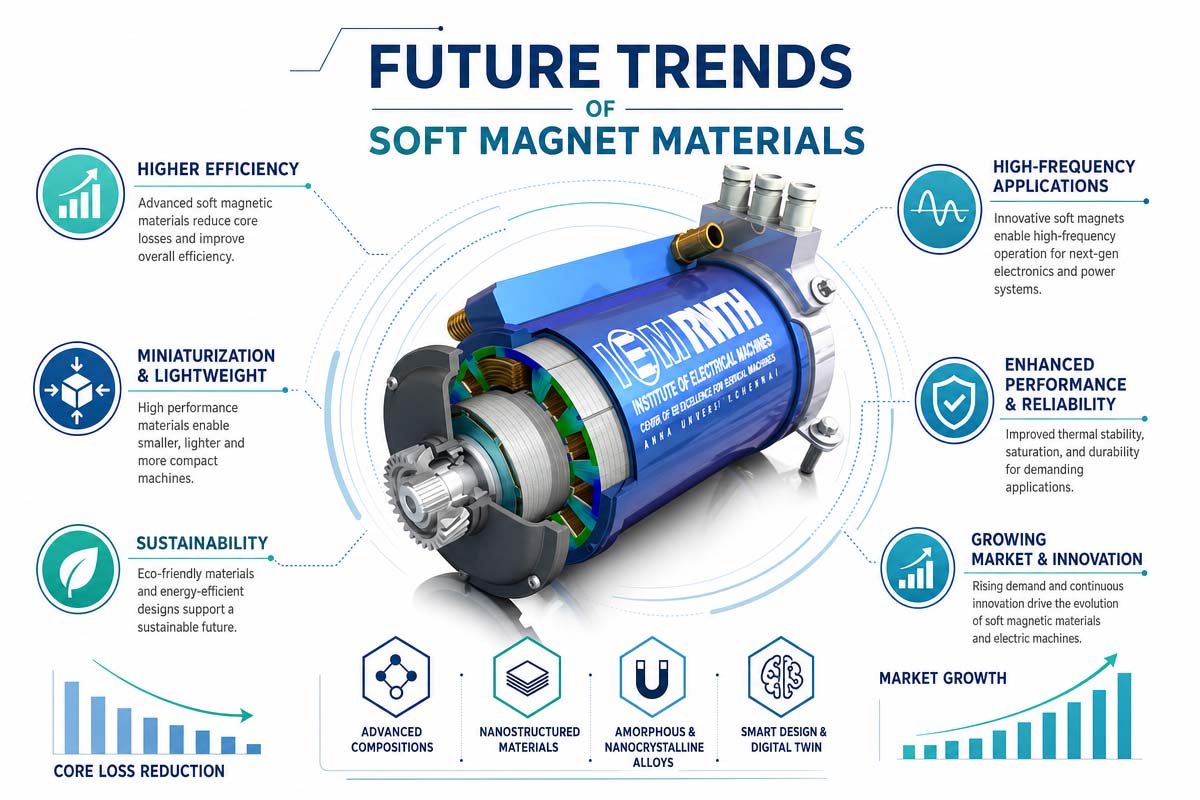
Thanks to the following development trends in the future:
Electric vehicles
Renewable Energy Sources
AI data center
5G & 6G communication
Smart Manufacturing
High Efficient Motor
Trends in the development of the future are:
8.1 Low Loss High Frequency Materials
Amorphous and nanocrystalline soft magnetic materials will replace conventional silicon steel.
8.2 Miniaturization
Ultra-thin and high-permeability soft magnetic material is available.
8.3 Sustainable Manufacturing
Energy-efficient manufacturing and Intelligent Manufacturing become standard.
8.4 Domestic production growth
The domestic production of high-end soft magnetic material has been increased to meet demands.
Chapter 9: Conclusion
All electromagnetic systems are relying on soft magnetic materials. For different application purposes, the materials such as steel, silicon steel, Permalloy, ferrite, and other materials have their pros and cons.
There is no best choice. The basic condition for electromagnetic efficiency is the matching of working conditions and materials.
Chapter 10. Frequently Asked Questions Regarding Magnetic Soft Materials
10.1 What is soft magnetic material?
Soft magnetic materials are ferromagnetic materials which can easily be magnetized and demagnetized. High magnetic permeability, low coercivity and low hysteresis loss. They are suitable for making electromagnets, transformers, motors, inductors, and other electromagnetic devices.
10.2 What is the difference between soft magnetic materials and hard magnetic materials?
Soft magnetic materials will lose magnetism very fast once the external magnetic field is off; hard magnetic materials will keep having strong permanent magnetism. Soft magnetic materials are mostly used in electromagnetic induction devices, while hard magnetic materials are used in permanent magnets.
10.3 Why is silicon steel so widely used in transformers and motors?
Silicon steel is known for low magnetic loss, good magnetic permeability and efficiency in AC environment. Increase in electrical resistivity decreases eddy current losses. It is one of the best core materials for transformers and electric motors.
10.4 What are the merits of ferrite magnetic materials?
The advantages of ferrites include:
Very low high-frequency loss
Good electrical insulation
Good EMI suppression properties
Good thermal stability
Light weight frame
Because of all those reasons ferrite is very appropriate for use in switching power supplies, wireless chargers, high-frequency communication electronics and others.
10.5 What is Permalloy?
Permalloy is an alloy with high magnetic permeability used primarily in precise electromagnetic applications where sensitive response to weak magnetic fields is necessary. Typical usage is:
Precision transformers
Magnetic sensors
Relays for communications
Instrumentation
Signal detectors
10.6 The best magnetic soft material for high-frequency applications is:
Ferrite is the preferred magnetic soft material for high-frequency applications because of its extremely high resistivity and minimal eddy current loss. Works great in MHz-frequency ranges.
10.7 Why do soft magnetic materials get hot?
Reasons for getting hot are:
Eddy current losses
Hysteresis losses
Material misuse
High frequency operation
Use of materials with lower losses such as silicon steel laminations or ferrite cores will greatly reduce heat generation.
10.8 What causes residual magnetism in electromagnets?
In cases when magnetic domains cannot return to disordered state even after removal of magnetic field residual magnetism occurs. Materials with higher coercivity tend to retain some residual magnetism.
10.9 How to choose soft magnetic material?
Selection of material depends on:
Operating frequency
Type of current (AC or DC)
Temperatures conditions
Stresses (mechanically)
Requirements to magnetic susceptibility
Etc.
Examples:
DC electromagnets – pure iron
Silicon steel – AC motors, transformers
Low-field magnetic systems – permalloys
High-frequency electronics – ferrite
10.10 What are nanocrystalline soft magnetic materials?
Nanocrystalline magnetic materials have ultra-fine crystal structure. Provide:
Minimal core losses
High magnetic susceptibility.
Very good performance at high frequencies
Increased energy efficiency comparing to conventional silicon steel.
Widely used in new energy equipment, EV charging stations and efficient power electronics.
10.11 Why is magnetic permeability important?
Magnetic permeability is a measure of how easily the substance conducts magnetic flux. Higher permeability allows creation of magnetic field of higher intensity using less energy from the electromagnets and transformers.
10.12 Is it possible to use regular steel for transformers instead of silicon?
It is not advised. Regular steel causes many losses increasing significantly the energy consumption and overheating of the device, resulting in decreased efficiency and reduced service life of the transformer. Transformer core should be manufactured from special silicon steels.
10.13 What could be considered failures of soft magnetic materials?
Failures usually occur in cases of:
Increased core temperature
Magnetic saturation.
Re-magnetization
Ferrite core cracking
Increased magnetic losses
Mechanical stress induced low-permeability
All of those issues can be avoided by using proper material selection and manufacturing technologies.
10.14 Are there ways to recycle soft magnetic materials?
Yes. Most magnetic soft materials such as silicon steel, ferrite, iron alloys etc. can be recycled and reused in industry.
10.15 What industries require soft magnetic materials?
Commonly used in:
Automation Industry
Power production industry
EV industry
Renewable energy industry
Household appliances industry
Telecommunications industry
Medical equipment
Aviation systems.
Smart manufacturing industry
