
The quality control of inductor coils involves all stages of its manufacture, from checking incoming components through processing controls, finished product checks, and ending with storage control. The central aim is to ensure that inductors meet the specified parameters in terms of their electrical, physical, and reliability performance. The following is a discussion on control points and methods:
Chapter 1: Incoming Material Inspection (IQC): Control Key Materials at the Source
The inspection of incoming material is considered to be the first step in validating product quality, with a focus on material types such as enameled wire, cores, frames, and leads. Some of the most important points for inspection are:
1.1 Enameled
- Verification of Specifications
- Verification of wire diameter and thickness.
- Verification of the operating temperature.
- Performance Evaluation: Assess enamel adhesion, scratch resistance, and breakdown voltage.
- Appearance Check: Verify the presence of oxidation, peeling, or foreign material on the surface.
1.2 Core Material Verification:
Usage of material analyzers to verify the base materials including manganese-zinc ferrite and nickel-zinc ferrite.
Dimension Check: Verify the outer diameter, inner diameter, height tolerance, and air gap sizes as applicable.
Appearance Check: Examine the material for the presence of cracks, chips, air pockets, or contaminants on the material’s surface.
1.3 Frame and Leads:
Dimension Check: Ensure the frame’s shaft diameter, lead spacing, and length correlate to manufacturing standards as well as PCB loading requirements.
1.4 Materials Check: Verify the resistance to temperature and flame retardation abilities, as well as tin plating thickness and oxidation resistance for leads.
Chapter 2: Process Control (IPQC): Mistake-Proof Production Process
Process control becomes necessary for ensuring that a certain level of quality is maintained, and defects are prevented from occurring.
Each process has control points.
2.1 Winding Process
Key Parameter Control: Turn number is a very important factor; it has to be controlled precisely (by winding machine counter, with an error of no more than ±1 turn). The tension during winding is also an important factor; excess tension may make the wire thin, whereas insufficient tension may make the coils loose. Also, the winding alignment should be flawless.
2.2 Mistake-Proofing Activities:
Confirmation of first piece is important; inductance and DC resistance checks are necessary.
Hourly spot checks should be performed in order to register winding values.
2.3 Lead Soldering & Wire Extension:
Soldering Control: The soldering temperature and time may need control. The soldering temperature can be around 350-400°C. The soldering time may also need control. The soldering time may be around 2-3 seconds.
2.4 Insulation Check: An insulation resistance tester is employed to check that the wires are unconnected to the frame and core. This resistance should be >100MΩ at 500V DC.
2.5 Dip-Coating and Curing Process
Resin Control: Use the specified resins for insulation and mix these resins correctly, without any contaminants that may affect insulation.
2.6 Curing Parameters: The prescribed curing parameters (such as 120°C for one hour) must be followed to achieve full curing. This step plays a significant role in increasing resistance to vibration and protecting the material from moisture.
2.7 Core Assembly Process:
Assembly Requirements: Ensure a tight fit of the cores; spacers can be used, if required. Adhesive tapes or clips should be firmly secured, without any play.
2.8 Appearance Control: Check for damage to the center by ensuring that there are no disturbed coils and that there are no bent leads.
Chapter 3: Finished Product Testing (FQC): Comprehensive Performance Validation and Sorting
The most urgent phase is testing the final products. They will verify if products meet standards. These tests cover electricity, physical, and reliability standards.
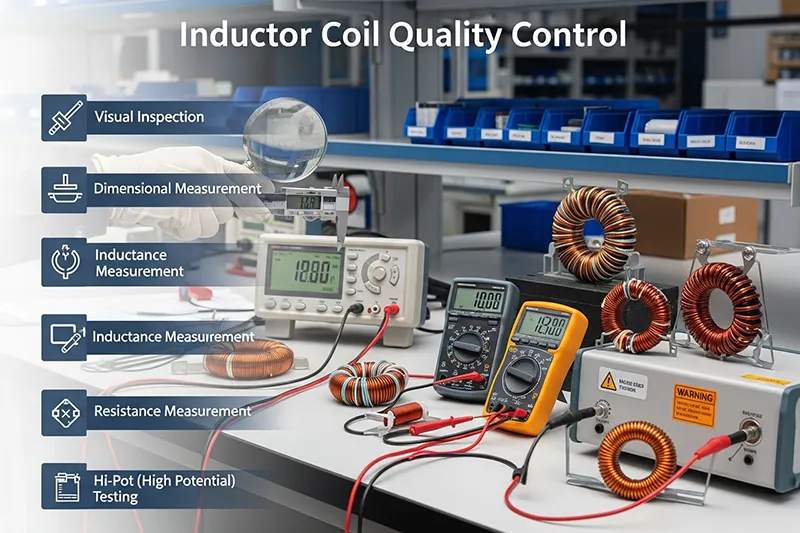
3.1 Electrical Performance Testing:
- Inductance (L): Tested using the LCR meter, with the value of the deviation being within ±5% or ±10% depending on the customer’s requirement.
- DC Resistance (DCR): Test using a micro-ohmmeter or an LCR meter to verify the resistance value within specification.
- Quality Factor (Q): Tested with the LCR tester at the given frequency to ensure Q ≥ the value mentioned as the standard (as a higher Q factor reflects lower losses for the coils).
- Saturation Current (Isat): Use a DC bias power supply and LCR tester to verify the current at which a 10% reduction in inductance is ≥ the rated current.
- Temperature Rise Current (Irms): Employ a thermal aged test cabinet to ensure that coil temperature rise ≤40°C (as per customer specifications).
- Insulation Resistance: The use of an insulation resistance testor checks for a value of ≥ 100MΩ between coil, wire, and core.
- Withstand Voltage Dielectric: Conduct a withstand voltage test (for example, AC1500V for 1 minute). There shall be no breakdown or flashover.
Physical Performance Testing:
Appearance: You need to make sure that the coil does not have any signs of damage, that there are no bubbles in the resin layer, and that the leads are not oxidated or deformed.
Dimensions: You are required to check the height, lead spacing, and lead length to make sure they meet the tolerances of the specified drawing.
Adhesion: Ensure the tape/clips are properly attached and the leads have adequate tensile strength.
3.2 Reliability Testing (Sampling)
- High/Low Temperature Cycling: Expose the device to a temperature range of -40° to 125°for 1000 cycles, ensuring that the inductance variation is within ±5%.
- Humidity Test: The components shall be subjected to 85°C and 85% RH for 1000 hours, thereby checking if the insulation resistance has decreased.
3.3 Vibration Test: Vibration should be induced in accordance with standard vibration conditions and should not exhibit any looseness in the structure or deterioration in the electrical performance.
3.4 Kontrol Pembungan dan Peng
Storage and shipping management practices play a critical role in protecting the inductors from being damaged during the processes of storage or shipping.
Storage Management: Environmental Requirements: The warehouse environment should be dry and well-ventilated. The temperature in the warehouse should be maintained at 25±5°C. The humidity should not exceed 60% RH. This is extremely important to keep the cores from getting damaged due to moisture and to prevent the leads from oxidizing.
Storage Method: Items should be stored depending on their batch and specifications. One should not squeeze them since this will cause the leads and cores to bend.
3.5 Shipping Inspection (OQC0)
Sampling Standard: The sampling should follow the GB/T 2828.1 standards. This is to examine the packaging, labels (including specification, batch number, and date of production).
3.6 Consistency Verification: Samples of the product will be randomly selected to retest the inductance value and the appearance to verify consistency with the FQC.
Chapter 4: Quality Abnormality Handling
It is necessary that if any quality issues come up, they are addressed at once.
Material flow Incoming Material Abnormalities: Separate problematic materials and notify the suppliers for corrective actions, then confirm the corrective measure taken.
Process Abnormalities
If there’s a problem, such as an incorrect value for inductance, halt production and determine why. This may be a result of incorrect turns or even an incorrect core material. Change parameters and ensure the first unit satisfies the testing requirements.
Finished Product Non-Conformance: Determine the type of non-conformance, which may be electrical or appearance-related. Then, identify the cause of non-conformance and take appropriate actions.
Chapter 5: Frequently Asked Questions
1. How can the quality of enamelled wire be ensured?
The trick is to examine its specifications, functionality (enzymatic bonding, insulation strength), and visual characteristics. All these components should conform to the standards necessary to prevent electrical breakdown.
2. How would we troubleshoot if the value for the inductance is not within limits?
We would first check the turns and soldering specifications. We also would not forget to check the core type. After that, we will improve our process and check our results with First Piece Testing.
3. What if the finished products have low insulation resistance?
Examine both the insulation used as well as the soldering technique. Should there be problems with production, adjust parameters accordingly. Should it occur on the materials side, notify the manufacturer accordingly to resolve such issues.
4. What should happen to the cracked cores?
A cracked core is harmful to the inductor. These pieces will have to be set aside and investigated for the possible cause. This may be due to some mechanical damage that occurred during assembly.
5. How can storage be managed in order to avoid any damage?
The environment in the warehouse should be dry and have a constant temperature and level of humidity. Store the products by batch and specification in a way that avoids deformation and damage while in transport.
Chapter 6: Summary Quality control of the inductor coil
Coil is an organized function that consists of several steps. Quality inspection of the raw material received or manufactured processes, product verification, and warehousing ensure the quality of every inductor coil utilized in practical applications. Every stage of the entire quality control process is an essential element for ensuring the delivery of quality products as required by the customer. For ensuring the quality of the inductor coil in all aspects
