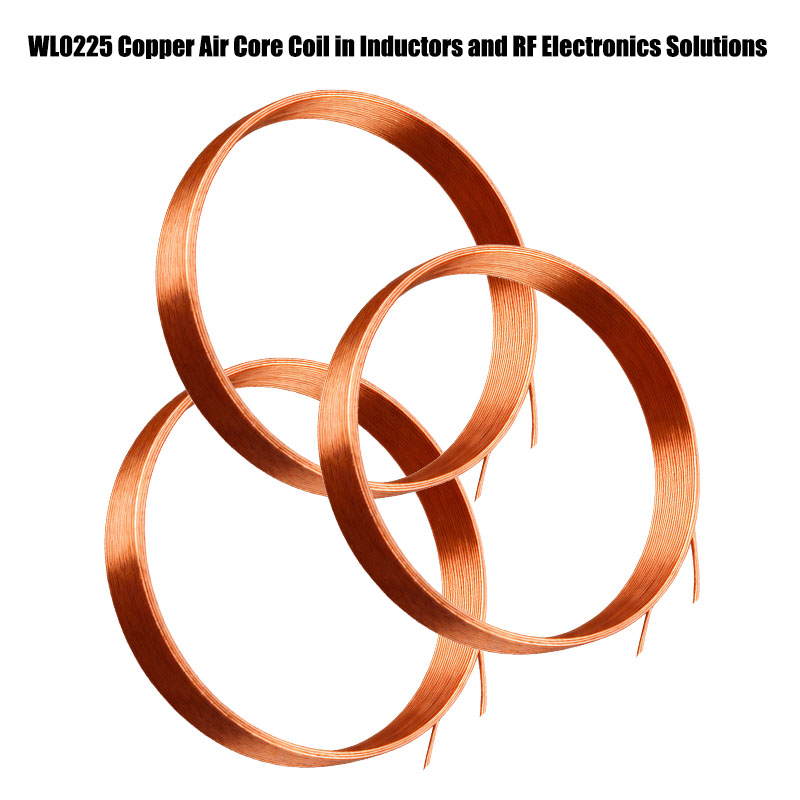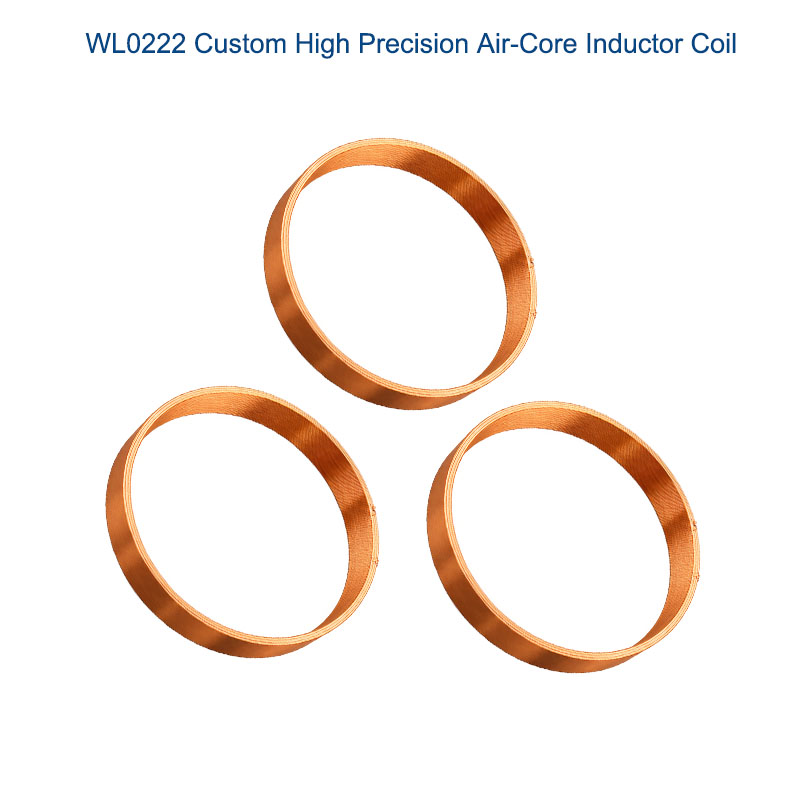
Introduction to Bobina de núcleo de ar Manufatura
One of the most significant performance and reliability problems associated with air core coils is overheating. Too high a temperature could increase the electrical resistance, destroy insulation, shorten the lifespan of the device, affect the stability of the inductance, and ultimately lead to the failure of the equipment in which the coil operates. To prevent these problems, one should understand the principles of designing and manufacturing air core coils.
An air-core coil contains no magnetic core material, unlike ferrite or iron-core inductors. It eliminates magnetic core losses and the saturation of ferromagnetic materials; however, there could still be heat generation. The temperature increase could be triggered by copper resistance, the level of current, winding geometry, operating frequency, the ambient temperature, and the installation conditions.
Therefore, proper thermal management should be implemented for the entire process of producing air core coils, from engineering calculation and wire choice to winding, inspecting, testing, and the final application.
1. Why the Air Core Coil Gets Hot
Before one can think of solving the overheating problem, one needs to understand its source.
The flow of current in the coil conductor causes heat losses because of electrical resistance. A simple formula for resistive power loss is:
P = I²R, where
- P = power converted to heat
I = current flowing in the coil
- R = electrical resistance of the winding.
This formula makes it evident that heat generation depends on the square of current. Therefore, even a slight increase in the current could result in a drastic increase in resistive heating.
At higher frequencies, the skin effect and the proximity effect can additionally increase the effective AC resistance. The importance of thermal performance is highlighted by the fact that air core coils are usually produced for use in RF equipment, high-frequency power electronics, wireless systems, filters, transmitters, or specialized industrial electronics.
Therefore, a suitable design should consider the actual operating conditions of the coil and not only nominal inductance.
2. Choose the Right Wire Materials
The wire diameter directly affects the temperature and resistance of the coil.
The wire would be too thin to handle the necessary current and have too much resistance. Such resistance causes heat loss while the current is passing through the winding. The increase in the cross-sectional area of the conductor reduces the resistance to DC and may improve current-carrying capability.
However, using the thickest wire available does not solve all the problems.
More wire affects the following factors:
- Measurements of the coil
- Number of turns that could be placed in a given space
- Geometria de enrolamento
- Indutância
pesos
- Custo do material
Dificuldade de fabricação
The manufacture of professional air-core coils requires balancing the electrical, mechanical, thermal, and cost requirements.
When asking for an RFQ from a manufacturer of air core coils, one should specify the following: expected continuous current, peak current, duty cycle, operating frequency, allowable temperature rise, and dimensional limitations. This will allow us to recommend an appropriate conductor rather than choose wire on the basis of inductance alone.
3. Reduce Winding Resistance
While evaluating the performance of an air-core coil, one needs to pay attention to the DC resistance, which is sometimes denoted as DCR.
Generally speaking, the higher the resistance, the greater the I²R loss for the same current level. Even with perfect inductance, the coil is inefficient if the winding resistance is too high.
The following design factors affect the resistance: wire diameter, total length of the conductor, number of turns, diameter of the coil, winding geometry, and the material of the conductor.
While manufacturing air-core coils, the resistance should be considered as a controlled electrical specification and not the byproduct of winding the necessary number of turns.
In case the resistance is vital for the operation, the buyer should specify the maximum allowable DCR. The manufacturer should then compare production samples and finished components to this specification.
4. Increase the Number of Turns
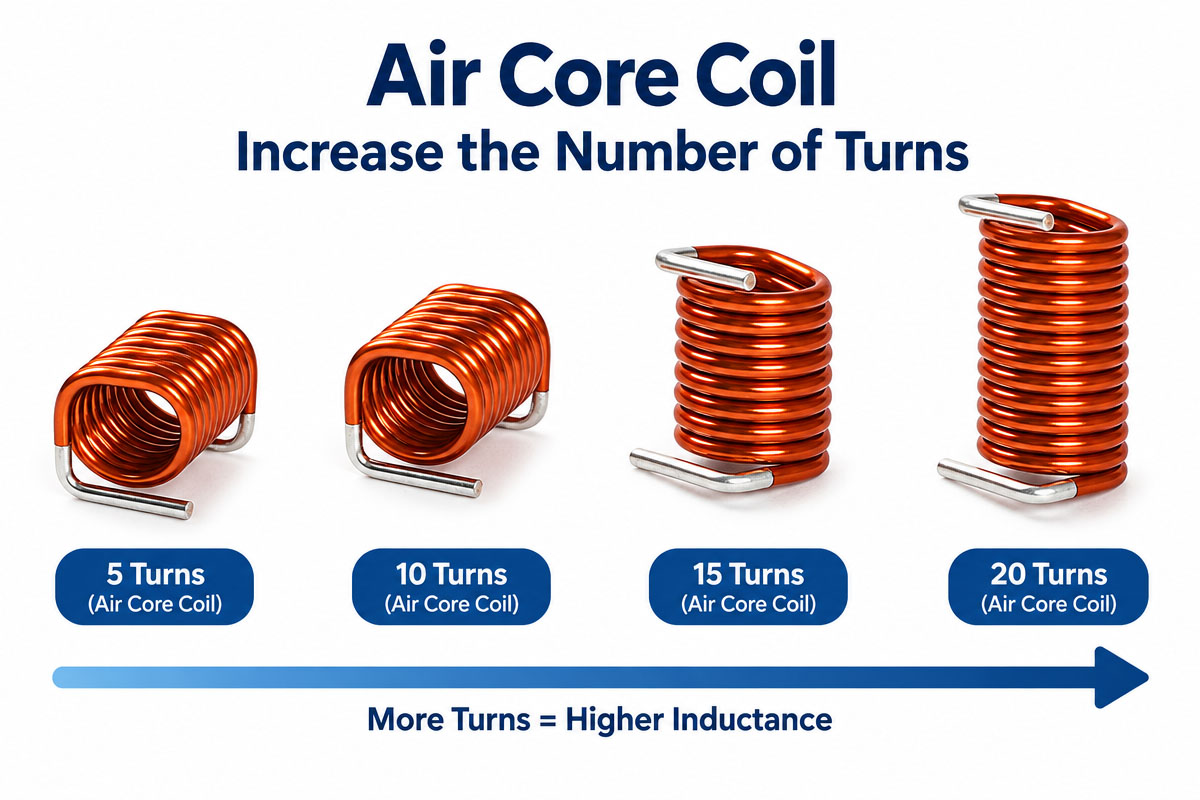
More turns do not mean a better coil.
The number of turns affects inductance, resistance, physical size, parasitic capacity, and thermal characteristics. The increase in the number of turns increases the total length of the conductor, and this increase could increase resistance and heat generation.
A suitable design should provide the necessary electrical characteristics without having overly long conductors.
This is why the experience in engineering is extremely valuable. The manufacturer of air core coils could adjust the coil diameter, coil length, wire size, spacing, and number of turns to optimize inductance and thermal performance.
For custom products, the buyer should specify performance requirements and not unnecessarily limit all the design variables. Giving some engineering freedom to the manufacturer will allow them to decrease resistance and improve thermal performance.
5. Take Into Account High Frequency AC Losses
When a coil operates at high frequencies, DC resistance alone does not provide a complete understanding.
The current distribution in the conductor becomes uneven at higher frequencies. Due to the skin effect, the current is flowing close to the surface of the conductor, and this phenomenon decreases the cross-sectional area of the conductor where the current is flowing.
Additionally, the proximity effect changes the current distribution because of the electromagnetic interaction between nearby conductors or turns.
Therefore, the AC resistance and heat generation become higher.
The manufacture of a high-frequency air-core coil requires engineers to take into account the effect of the conductor type, diameter, winding separation, geometry, and operating frequency.
In certain cases, other configurations of the conductors can be used to reduce losses at high frequencies. It depends on the frequency, current, space, inductance requirements, and cost.
Buyers should specify the actual operating frequency or frequency range and not just the inductance and dimensions.
6. Improve Winding Geometry and Winding Spacing
The winding geometry influences the appearance of the finished coil greatly.
The parasitic capacity, proximity losses, airflow, and heat distribution depend on the tightness of turn packing. In certain cases, the turn-spacing could be used to improve electrical characteristics and heat dissipation.
The wider spacing increases the physical length of the coil and can change its inductance.
Therefore, consistency of winding geometry is vital in the manufacture of precision coils with air cores.
The manufacturer should control the following factors:
*Number of turns
Diâmetro da bobina
Enrolamento de passo
Espaçamento das curvas
Comprimento do enrolamento
Papel de liderança
Form of the mechanical
Repeatable winding processes guarantee consistent thermal and electrical performance from production batch to production batch.
7. Choose the Air Core Coil Right Insulation
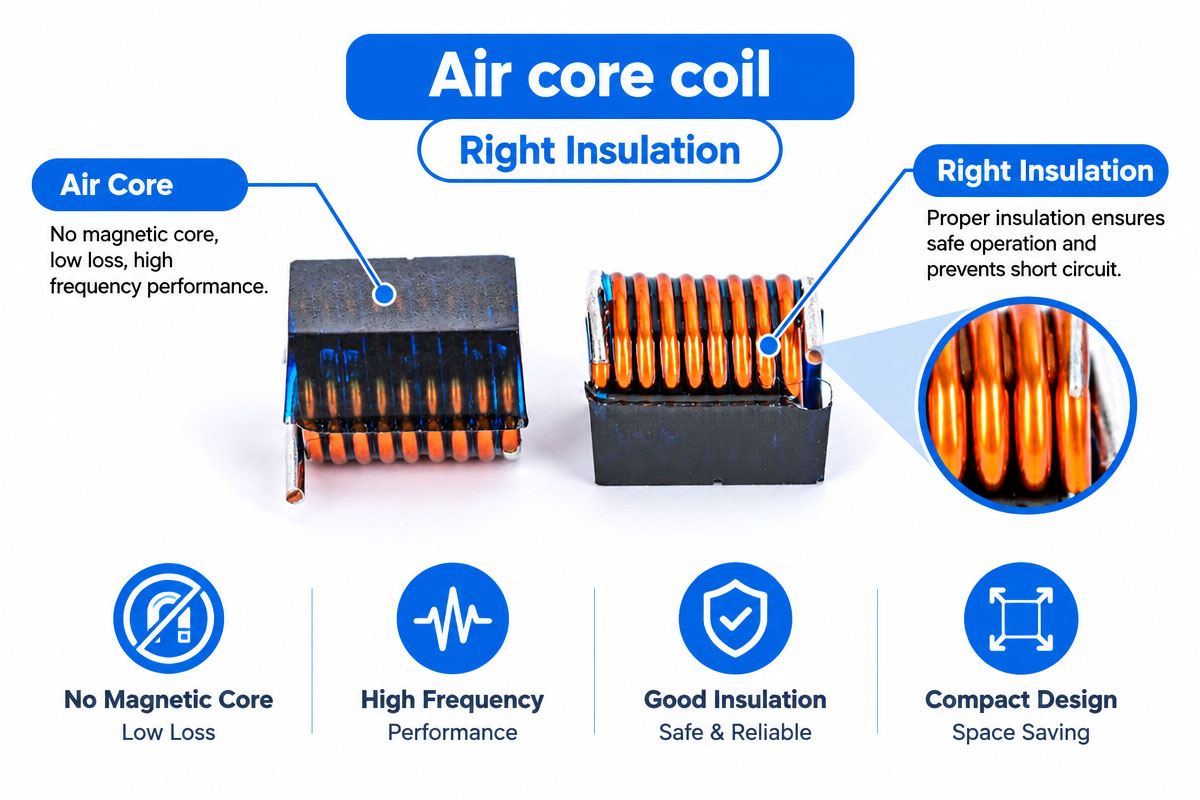
Another important factor to prevent overheating is wire insulation.
The insulation system should have the ability to withstand the expected operating temperature with an adequate safety margin. If the winding temperature exceeds the thermal capability of the insulation, it will start to degrade over time.
Depending on the application, the thermal aging could cause cracking, reduction of the dielectric strength, shorted turns, or premature coil failure.
Therefore, during the insulation selection for the manufacture of air core coils, normal operating conditions and abnormal but foreseeable temperature exposure should be taken into account.
It is necessary to ask for wire insulation type and temperature rating for industrial equipment, automotive electronics, and power systems and applications subject to high ambient temperatures.
8. Ambient Temperature Considerations
An air core coil does not work alone.
A design that works fine at room temperature in an open laboratory may act quite differently once installed inside a sealed enclosure along with heat-generating electronics.
The ambient temperature affects how easily heat can dissipate from the winding.
For example, the coil operating near the heat-emitting components like power semiconductors, transformers, motors, batteries, or others might already operate at an elevated temperature.
So, the specifications for manufacturing air core coils should take into account realistic environmental conditions.
The important information is the maximum ambient temperature, type of the enclosure, ventilation, airflow, heat sources in the vicinity, mounting method, and the expected duty cycle.
This way one can avoid a common procurement pitfall, buying a coil that performs well against electrical specifications but overheats in the actual product.
9. Provide Adequate Ventilation and Heat Dissipation
Thermal management continues even after the coil leaves the plant.
Natural convection or forced air flow can affect the temperature of the coil. Product designers should not locate heat-sensitive coils in areas with restricted airflow unless the component was designed and validated for such a situation.
The adequate spacing around the component will help with heat dissipation.
In certain specialized applications, additional thermal management measures could be necessary. They depend on the mechanical and electrical characteristics of the final equipment.
A reliable manufacturer of air core coils will be willing to discuss the proposed installation environment, not just looking at the coil as a separate component.
10. The Winding Process Control
Even the best design of the coil cannot guarantee its correct operation if the manufacturing process is inconsistent.
Manufacturing variation can affect dimensions, resistance, inductance, spacing, and mechanical parameters. Inconsistent winding tension can result in geometrical changes and the appearance of the mechanical stress. Process control is essential for large batches where the buyer expects the thousandth part to behave like the approved sample.
In the production of high-quality air-core coils, we shall apply controlled winding parameters, adequate production equipment, written work, and inspection instructions.
It is useful for custom coils to have samples of the first article. The buyer can test them in his application before approval of mass production.
11. Testing of Inductance and Resistance
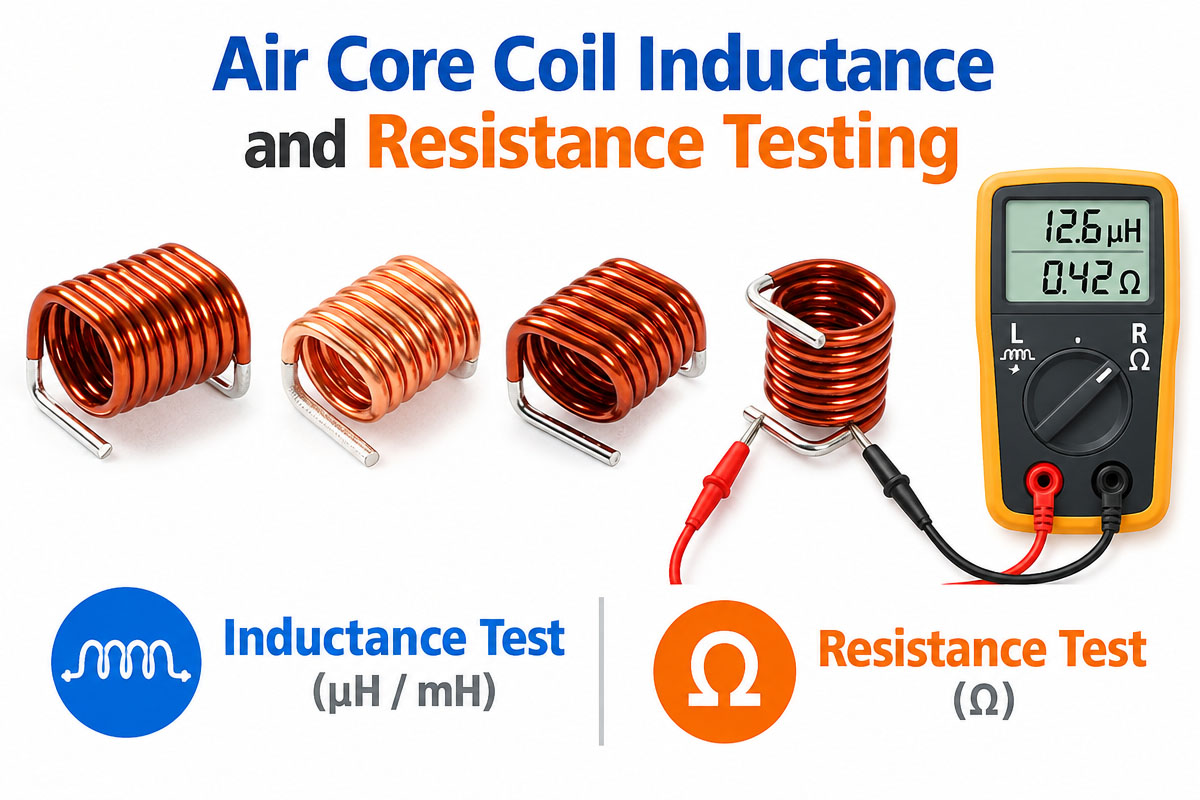
Electrical testing is one of the simplest methods of detection of potential manufacturing issues of the coil before delivery to the customer.
Inductance is proof of the electrical functioning of the coil. Measurement of the resistance can indicate the winding condition, which can cause unexpected heating.
Other tests may include dimensional inspection, insulation testing, continuity testing, visual inspection, high-frequency measurements, and thermal testing, depending on the application. An inspection plan in accordance with the critical specifications of the component is required for reliable air-core coil manufacturing. The buyers should state the tolerance and acceptance criteria in the drawings, specifications, purchase documentation, or agreed technical documentation.
12. Conduct the Temperature-Rise Testing
Temperature rise testing can provide valuable validation in case of applications where overheating is the issue.
In addition to theoretical calculations, the engineer can test the coil under specified current, frequency, ambient temperature, and installation conditions and record the results of the thermal test. Some questions that testing can answer are the following:
“How hot does the winding get when operating continuously?” Is the temperature at an acceptable level? What happens under maximum load? Does the coil comply with the limits of the insulation system?
It is very beneficial to conduct temperature-rise testing before starting large-scale manufacturing of air core coils.
The prototype testing provides the possibility to conduct engineering changes before tooling, production planning, stock, and final assembly when making changes becomes more expensive.
13. Don’t Exceed Rated Current
Even a well-designed coil can overheat while operating beyond the intended conditions.
Therefore, current ratings should be determined carefully and known to both the coil manufacturer and the equipment designer. Continuous current and peak current for a short time are not necessarily the same. Important is the duty cycle. The coil’s thermal behavior when operating for a short time under high current can differ from its behavior when running continuously under the same current.
One of the things to avoid is providing an air core coil manufacturing supplier with only one current figure without giving a detailed description of the intended operation.
With the load profile specified, the engineering team can design the coil suitable for the intended operating conditions.
14. Consider the Air Core Coil Manufacturing Consistency and Tolerances
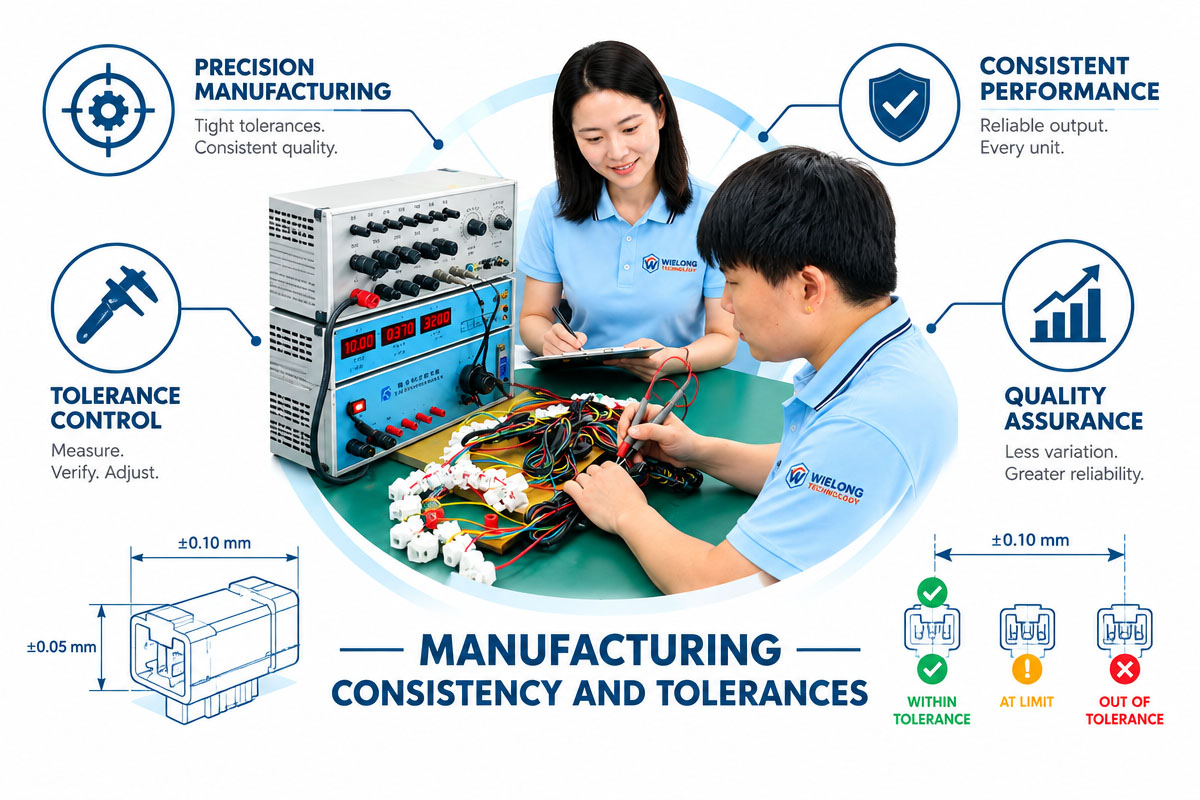
A good-performing prototype doesn’t suffice for OEM procurement.
Production parts must be in acceptable limits across several lots. Manufacturing variations such as wire diameter, winding size, numbers of turns, connection quality, etc. can influence resistance and thermal performance.
Therefore, the buyers need to go beyond the prototype and to consider the controls in place with the supplier.
Before qualifying the manufacturer of air core coils, the buyer should ask about the incoming material inspection, winding process controls, electrical testing, traceability, calibration practices, nonconforming material procedures, and final inspection of the parts.
It is particularly important for the products expected to have a production life of several years.
15. Collaboration with the Fabricante de bobinas de núcleo de ar From the Very Beginning
One of the best ways to avoid overheating is to involve the coil manufacturer before the design is completed.
If all dimensions and parameters are fixed, then the supplier may have difficulties in optimizing wire diameter, winding geometry, spacing, resistance, or manufacturability. Early collaboration gives more freedom in design. The experienced air core coil manufacturing supplier can discuss together with the customer the target inductance, current, resistance, frequency, size, temperature, and mechanical requirements.
Such an approach to the design of the product can optimize performance and also cost and lead time of production.
16. Information to Include in RFQ
Detailed RFQ can greatly reduce misunderstanding between the buyer and coil supplier.
Don’t say just “air core coil” with some inductance. Please provide as much information about the application as you can. Useful information to include in RFQ: inductance and tolerance, maximum DCR, continuous and peak current, operating frequency, coil dimensions, wire requirements, insulation requirements, lead length, termination style, operating temperature, environmental conditions, annual quantity and expected order quantities, and compliance requirements.
Having the clear specifications, the team that manufactures air core coils can assess the thermal performance prior to production.
In proprietary projects, some specifics of the application may be proprietary, but the supplier still needs sufficient electrical and thermal information to properly design the component.
17: Air Core Coil Manufacturing Conclusion
Choice of wire size or current reduction alone won’t prevent overheating. It takes a comprehensive approach, which includes conductor resistance, winding geometry, frequency, insulation, ambient conditions, airflow, manufacturing consistency, and application testing.
The best approach for OEMs and industrial buyers in resolving the thermal performance issue is to design it right from the beginning of the sourcing process.
A qualified manufacturer of air core coils should be able to discuss current requirements, DCR, frequency, winding construction, insulation, production tolerances, and testing and not just manufacture a coil according to basic dimensions.
With good engineering, controlled manufacturing, and realistic application validation, the buyers can decrease the risk of overheating, increase product reliability, and avoid expensive redesign after the start of mass production.
18. FAQs About Air Core Coil Manufacturing
1. What information should I provide to an air core coil manufacturer to obtain the quotation?
Specify desired inductance, tolerance, coil size, wire needs, DCR limit, operating current, frequency, temperature range, lead configuration, quantity, and any environmental or compliance needs. Also, it will be beneficial to provide a sample or drawing, if available. In case of custom air-core coil manufacturing, please specify operating conditions to allow the supplier to calculate electrical and thermal requirements.
2. How do I know if an air core coil will overheat in my application?
Start with winding resistance, continuous current, peak current, duty cycle, operating frequency, ambient temperature, and ventilation. One of the most useful techniques of the prototype validation is conducting temperature-rise testing under conditions as close as possible to the final application. In the case of applications with elevated temperature or high frequency, don’t rely only on resistance measurements taken at room temperature.
3. Should I specify maximum DCR when buying custom air-core coils?
Yes. This is especially important when resistance affects efficiency, voltage drop, temperature rise, or other aspects of circuit performance. Specifying a maximum DCR gives the supplier a quantifiable production requirement. But your DCR target should be technically realistic because lower resistance can require thicker wire or larger coil dimensions, increasing size and cost.
4. Will thicker wire solve my overheating problem?
No. Thicker wire can reduce resistance, but coil design is a complicated interaction of many parameters. Change wire diameter: affects physical size, winding length, number of turns, inductance, manufacturing process, and cost. Electrical and thermal analysis should be done to determine the optimum solution. One parameter changing shouldn’t be done.
5. What samples should I order before placing a large production order?
Order samples made of materials and processes representative of planned mass production. Inspect inductance, resistance, dimensions, fit, mechanical construction, and thermal behavior in the end use. For critical projects, establish an approved or “golden” sample, which can be used as the reference for future production.
6. What quality controls should I expect from a provider of air core coils?
Depending on your application, the controls will vary but can include verification of incoming material, controlled winding parameters, visual inspection, dimensional inspection, resistance measurement, inductance testing, final inspection, equipment calibration, and lot traceability. High-reliability component buyers should review the inspection plan before approving the supplier.
7. Can the air core coil manufacturing supplier modify the air core coil to reduce the temperature rise?
Yes, most of the time. Depending on design constraints, the manufacturer may be able to change parameters such as conductor size, winding geometry, coil diameter and spacing, turn layout, or other parameters. Available options are based on the desired inductance, current, frequency, size, and cost target. This is why early engineering collaboration is important.
8. How to compare two suppliers of air core coils?
Don’t just compare unit price. Compare engineering capability, material control, winding consistency, electrical testing, tolerance control, sample quality, production capacity, traceability, communication, lead time, and custom design capabilities. Lower initial component price can be costly if inconsistency in resistance or winding quality results in overheating, field failures, production delays, or redesign work.